For identical twin sisters who have
recorded and toured together over
the past ten-plus years, Tegan and
Sara live awfully far apart. Tegan
resides in Vancouver, and Sara is more
than 2,000 miles away in Montreal.
But it doesn’t hold them back. Early in
their career, Tegan and Sara Quin
caught the ear of Neil Young, who
brought them on tour with The
Pretenders in 2000 and signed them
to his label, Vapor. It’s been a whirlwind
ever since.
Although collaboration wasn’t
always a part of the duo’s process, for
2004’s So Jealous, which spawned
the indie hit “Walking With a Ghost,”
and 2007’s The Con, featuring the
single, “Back in Your Head,” Tegan
and Sara exchanged ideas online. For
their sixth album, Sainthood
[Sire/Vapor/Warner Bros.], the twins
came together even more, building on
each other’s ideas via their respective
Pro Tools rigs and writing together in
person. Meanwhile, Tegan worked
with AFI’s Hunter Burgan for a few
tracks. And in between, the girls collaborated
with trance superstar Tiësto
on “Feel It in My Bones,” from his latest
album, Kaleidoscope.
Tegan and Sara have a knack for
writing economical and catchy songs,
and there are lots of them on Sainthood.
For starters, check out the
hooky cadence of vocals and bass in
the chorus of “Night Watch,” the
jagged rhythms of “Arrow,” and the
pulsing arrow-to-the-heart, “On
Directing,” which features the line, “Go
steady with me./ I know it turns you
off when I get talking like a teen.”
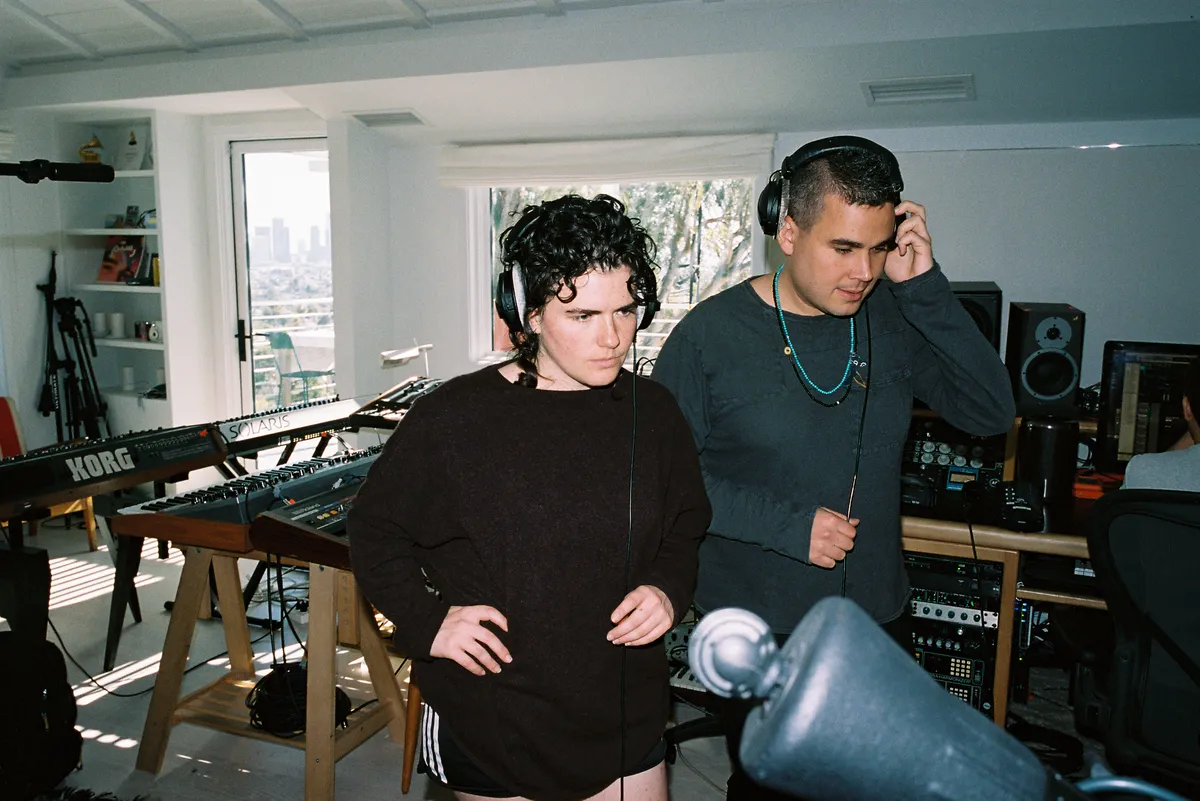
Tegan and Sara recorded
Sainthood at L.A.’s Sound City and
Seattle’s Two Sticks with producer/engineer
Howard Redekopp (The New
Pornographers, You Say Party! We Say
Die!), guitarist Edward “Ted” Gowans,
and one half of Death Cab for Cutie:
multi-instrumentalist/producer Chris
Walla (who played bass on Sainthood)
and drummer Jason McGerr. Here,
Tegan Quin, Walla, and Redekopp discuss
whittling down 50 songs, recording
live, doing hours upon hours of
takes, and sonic economy.
How did you start working with
Hunter Burgan?
Quin: Sara and I watched a documentary
about Tom Petty, and it was
like four hours of watching him write
with other people. So I thought it
would be really cool to write with
someone else. When Hunter and I
started writing together, I didn’t think
that anyone would ever hear it or
more so that Tegan and Sara would
ever do the songs, but it ended up
becoming this amazing place for me
to flesh out my ideas without feeling
insecure or uncomfortable. I had
someone there to support me.
When we started submitting songs
for this record, Sara was like, “Some of
these Tegan-versus-Hunter songs—
[“The Cure,” “Hell,” and “Don’t
Rush”]—are really amazing. I think if
we reconfigured the instrumentation
to make sense for Tegan and Sara,
they could be really strong songs.”
The main difference about me writing
with Hunter is that I’m less emotional
about the music and more open to
suggestion. When we sat down to do
“The Cure,” it was literally half the
tempo, and it was a piano ballad. Sara
was like, “It’s a cool song, the melody
is amazing, but I hate the instrumentation.”
And then the song completely
changed.
Sara and I went on a trip together
in November [2008], and we wrote six
songs in the same room with each
other. None of those songs made it on
the record, but it really inspired us.
[For example,] “On Directing” was
the last song that Sara wrote for this
record. It’s structured so well, and I’d
like to take credit for that because she
had to write with me. [Laughs.] I’m
really all about “Verse, chorus, verse,
chorus, bridge, double chorus.” And
Sara never does that! It’s always like:
verse, weird part, second weird part,
kind of a chorus, extended chorus,
weird part, weird part, weird part, chorus.
I thought it was really neat to see
her growth on this record ’cause she’s
starting to write more traditional
songs. I still don’t understand “Walking
With a Ghost,” and I’ve been playing
it for six years. It’s a great song,
but I’m like, “Which part is the verse?
Which part is the chorus?”
You had a lot of songs to choose
from for Sainthood. How did you pick
the final 13?
Quin: We submitted 50 songs, and
a lot of them I wrote in two hours
and never went back to again. There
was one I wrote when we were in
New Orleans that Chris Walla picked
on his list of potential songs, and Sara
hated it. We had a huge fight about it.
It’s so sad because one, the way other
people perceive your music can really
affect how you feel about it. And two,
sometimes I write so much that I don’t
spend the time to complete or rip
apart a song and start again. Maybe
there is something in that song that if
I went back and redid it, it might be
the song that changes our band’s
course in history. But I would rather
not go through the rest of my life
playing a song with Sara that she
doesn’t like.
[However,] I did rework one song a
few times that never made it, and I felt
so agitated. I was like, “I did everything
that everyone wanted. I wrote a
bridge, I sped it up, I rerecorded it, and
I don’t understand!” But the right
songs always float to the top.
Walla: In a batch of 50 Tegan and
Sara demos, there are countless
numbers of albums. You can configure
those 50 songs in any combination
and have 50 completely
different listening and emotional
experiences. There gets to be real
option anxiety at a point. But we set
half of them on fire and let them go.
And with the [remaining] 23, we just
ended up gravitating to whatever
worked. It’s a beautiful thing to be
able to do because you stop chasing
stuff that’s not coming together. If
we only had 12 songs, then you’d
have to make them all go.
Why did you decide to record the
bulk of Sainthood live? What was the
process?
Walla: Modern recording can be so
modular and piece-by-piece. There are
so many awesome records being
made that way, but if you have the
time and opportunity to set up and
cut something live that has a really
organic foundation to it, it seems like
it would be crazy not to try and do it.
Quin: When we walked into Sound
City, Ted, Sara, and I were playing
with this rhythm section [Walla and
McGerr] that hadn’t played the songs
yet. They’re so amazing that magic
happened right away, but we spent
between 35 and 50 takes honing in
on every little detail. Then there
would be that magical take where
we would all like laugh and be like,
“That was it!”
But it was freaking exhausting to
spend the first five hours a day getting
sounds and setting up
microphones, play until 8 o’clock at
night, and then have Howard be like,
“Okay, this is take 44. What do you
think of this one?” We’d be like, “Oh
God.” It was just insane when you
think of how much we played the
songs, and then you’d have to go to
bed for six hours and come back and
do it all again.
Redekopp: The first half of the 40,
50 takes would sound radically different
than the second half because people
were still changing things. The
song structure, melodies, and chords
were there, but it’d be like, “You know
what? I’m not going to play guitar. I’m
going to play keyboard.” And Chris
would be trying different basses, and
Jason would be like, “I don’t think this
part works with this drum.”
The concept was to just keep hitting
tape [Studer A827 2-inch with
Dolby SR], and once everyone out on
the floor came in and agreed that
these were the batch of takes that we
liked, we would transfer those into
digital [Apple Logic]. Invariably at the
end of five, six, seven days, we had to
start reusing tape, but by then we’d
already transferred all the keeper
takes. Some songs I kept maybe four
takes, and other songs we kept eight
just as insurance. But the principal bed
track was coming from one or two
takes. And I can count on my hands
and toes how many notes actually
physically got moved in time on a
computer. There’s comping involved,
but that’s really just choosing between
takes that worked and takes that didn’t
work as well.
What were the main instruments
used?
Quin: Chris has a crazy collection of
Rickenbackers, and Sara is a huge
Gretsch fan, so there was a smorgasbord
of Rickenbackers and Gretsches.
Sara has a couple of Malcolm Youngs,
and Chris and I have Duo Jets. There
are a few Les Paul and SG moments.
We didn’t really play acoustic guitar
very often on this record. I think the
acoustic is the lead instrument on
“Arrow,” and you can’t even really tell.
But we both have Art & Lutherie
acoustics and a good assortment of
Gibson Blues Kings.
Walla: Jesse Quitslund was the
Death Cab guitar tech for about three
years, and he built amps for Ben [Gibbard],
me, and Jason, who owns Two
Sticks. We played mostly Jesse’s
amps—they’re small and break up at a
really reasonable volume—but we also
used my ’64 [Fender] Tremolux.
For bass, it was an SVT Classic
head and an 8x10 cab with one of the
ZVex boost pedals for some of it. For
the most part, I played a ’77 [Fender]
P Bass that I love. There are a couple
songs that are an old ’70 or ’71 Fender
Mustang. And then there are two
songs that are an Epiphone Jack
Casady, which is a disaster, but it
sounds really cool. It’s such a bad best
friend, but if you put flatwounds on it,
it sounds amazing.
Jason’s got so many God damn
drum kits, I can’t even keep them
straight. But he’s a Ludwig devotee
through and through. Snare drum-wise,
we bounced around between a Ludwig
Black Beauty reissue and a couple old
Acrolites. The other one that we leaned
on a bunch is a WFL kit, which is a pre-
Ludwig company. It’s just huge and
warm and matched the room at Sound
City so beautifully.
Redekopp: Jason McGerr brought
at least 20 snare drums, three or four
full kit setups, and a massive array of
cymbals. It was all these different textures:
“Hi-hats? You want the 16-inch?
The stainless steel?” We’d be 20 takes
deep, and all of a sudden one of us
would go, “That hi-hat is bugging me.”
And so he’d change it out. And then I’d
be like, “Actually, that really works, but
we shouldn’t be using the [Neumann]
KM 84 anymore. Let’s put the SM7
back on the hat.”
And there were some tricks, too.
One of Chris’ tricks is taking an SM57
with an old barrel connector that goes
low impedance to high impedance and
plugging that into the SansAmp pedal,
then into a guitar amp or into a DI and
then into the desk [Sound City has a
Neve 8028].
Also, Sound City has this makeshift
booth on the floor that the assistants
refer to as the “Easy-Bake Oven”
because it gets pretty warm in there.
Behind it in the corner was this really
great low end happening, so we put a
U 87 mic there, which we called the
Easy-Bake mic. That was always my
“glue” mic. But my new one is a Sony
C37 as an overhead. Almost every single
time you’d turn that one on, and
it’d be like, “Oh! There you go.”
You recorded vocals and overdubs
at Two Sticks. Lots of takes there, too?
Quin: Howard would just be like,
“Let’s do it again, let’s do it again, let’s
do it again.” And I was just like, “Am I
terrible?! Either you guys are getting
more picky or I’m getting more terrible.”
And they were just like, “It’s
going to be a great vocal record. Just
like playing the song 45 times to get
the best drum and bass take, you’re
going to have to sing it 40 times to
get the best vocal take.” And I was
like, “F**k yoooou.” It breaks down
your spirit. There’s no doubt when I
finish making records, I never feel
elated. I just feel broken.
Walla: There’s this weird arc that
happens where the first few takes
have tons of energy but not a ton of
accuracy or detail, and then [the
singer] goes into a slump, and then
you get to about 15 takes, and it starts
to come back. Then the singer and
producer get frustrated with one
another, take a break, and eat dinner.
Then you come back, and it gets to a
point where it totally works.
There are a lot of varying philosophies
about first take versus last take
versus the right take versus chasing
something forever and ever, and all
the diminishing returns stuff, but it’s
just a matter of getting to the point
where you can absolutely verify that it
feels better than whatever the first or
most recent thing is that you did.
What was the signal chain for
vocals?
Redekopp: We had a couple Neumann
U 87s and a Neumann U 67.
There were a couple shout-y
background vocals where I had Tegan
four feet off of an [AKG C] 414, with
just the brightness of the room and
the mic. And there was one song
where she’s spitting out a million
words a minute with all that consonance
stuff happening. Not wanting to
beat the snot out of it with a de-esser,
I used a Coles ribbon mic, and it
worked great. It features a strong
double, so one of them is a Coles, and
the other is the 67.
We almost always used a Chandler
preamp and Manley Variable Mu—
[Walla also notes an Empirical Labs
Distressor]—and a really small amount
of de-essing, just grabbing the really
fast sibilant stuff. We were trying to
encode that because the vocals went
straight into Logic using the Nyquist
A/D converters that Chris has. I find
particularly when you’re encoding
vocals straight to digital, just a little
bit of de-essing on the way in to take
the edge off of the sibilance goes a
long way, but nothing heavy because
of course you’re not going to get that
back once you’ve destroyed it.
Chris, you mixed “Northshore,”
“The Ocean,” and “Arrow.” How’d you
approach those?
Walla: I’ve never mixed in or out of
Logic before, and I ended up doing it
mostly through the [Quad-Eight Electronics]
console. I summed a few
things together in Logic and sent
them out. But virtually all of the gain
reduction, compression, or smashing, I
did with outboard gear.
I did some pretty dramatic drumbus
compression with the Empirical
Labs Fatso and dropped snares and
toms back on top after the fact.
The gain structure’s kind of weird;
it’s cool to have it on 1 on the way in.
It’s not broken—it’s just kind of
strange.
I used the Chandler TG-1 compressor
and the Great River EQ-1NV a lot.
And then mix-bus-compression-wise, I
did a whole bunch of stuff on the
backend. I’ve got a passive Pultec filter—
not even an EQ, just a bunch of
transformers and inductors. I turned it
on but left all the filtering out, so it’s
basically just running through transformers.
From there, it went into a
Manley Variable Mu, Smart D2, and
GML 8200—where I did a little bit of
EQ on the tail end—and then I mixed
everything to 1/2-inch at 15 ips.
The album sounds full, but also
like you were economical with parts.
Quin: When we started breaking
drums, bass, guitars, and keyboards
into stems, I was shocked at how little
there was. I was like, “Really? There’s
only two guitars and that one
keyboard?” It’s so funny that it feels
so rich. And I didn’t do a lot of double
vocals, which has been sort of our
sound, to always have 900 of our
vocals smacking you on the face.
There’s something really weird and
vulnerable about doing that.
Redekopp: Anybody can keep
stacking things up until it sounds cool.
But to stay economical puts a huge
burden on the performance, and then
it sounds more honest in the end. The
reason why the record is able to
sound that way is because the emphasis
was again and again on performance.
That goes back to not making
a record where the artist is able to
look at somebody at the computer
and go, “You got what you need,
right? Can you tune that? You can fix
the timing on that, right? I’m going to
go get some food.” It’s a wonderful
tool when you get this great performance
and there’s one little flaw. But
not when it feeds and informs the way
people write music. There was none of
that on this record.
Walla: Economy was one of the
words that we threw around a lot
when we were first starting to talk
about this record. I think a lot of songwriters
just throw stuff in for varying
degrees of insecurity about the song.
Like, what makes this one tiny little
keyboard part any more or less important
than any of the other ones?
Sometimes taking something away
is the thing that makes the whole
song work. When the bridge went
down on the floor for “The Cure,”
nobody quite knew what to play guitarwise
and keyboardwise. So we
made a decision on the floor to just
leave it as bass and drums. As we got
further into the song, it was like,
“That’s what goes there! Tons of
vocals.” You do miss the guitars, but
when they come in, it’s a big breath of
fresh air.
How did Sainthood compare to
past recording experiences?
Quin: The Con was a weird record
because we didn’t do it with a band.
Jason flew in and added his drums,
and Hunter flew in and did his bass. I
didn’t even know how to play half of
the songs. I’d written them, and then
six months had gone by, and there I
was trying to record them.
This record was all about the
group. Jason would tell me what he
thought about my guitar tone. That’s
never happened before. We’ve always
had amazing musicians play with us,
but they felt like drummers that we
hired. Because Jason’s in a band, he
was speaking to me as my equal.
Meanwhile, Ted would march over to
Chris and say, “I think you should try
this bass idea.” I’d be sitting there like
[whispers], “Oh my God. Ted is talking
to Chris about what his bass part
should be!” It was fascinating. But we
made a band record. We became
Death Cab for Tegan and Sara, and it
was pretty awesome.
DISORDER TO DESTROYER
Chris Walla on his prized Lexicon Varispeech: “There was a lot of speech
pathology research developed at Lexicon that was cross-purposed into
pro audio. The Varispeech was originally intended to help stroke victims
and people with speech disorders. The idea was that you could slow down
a conversation at regular pitch but keep pitch where it was so that people
could practice figuring out how to reconnect their mouth and their brain.
“There was this weird period where [Lexicon was] screwing around
with it; I got one that had a feedback knob, which as far as I can tell is
completely useless for speech pathology, but it makes everything sound
like Doctor Who, which is awesome.
“It sounds great under the snare drum, and Tegan’s vocals run through
it on ‘The Cure’ when she does the ‘Oh, uh oh, uh oh’ thing. The
Varispeech is a really cool chorus-y, flange-y thing if you set it up that way.
But it’s a speaker destroyer, too. It’s an old [’70s] effect, and Lexicon
wasn’t worried about being sued by guys who were like, ‘You blew up my
guitar amp, dude!’”