By Kylee Swenson | Tue, 01 Jun 2010
Until recently, Caribou’s Dan Snaith
didn’t know how to swim. But his wife got
him swimming lessons as a Christmas
present, and now when he’s not making
music, he’s in the water. In fact, swimming
became the production concept
for his latest album, Swim (Merge).
Snaith, who has also released
albums as Manitoba and has a Ph.D in
mathematics, decided to bring the
aural effects of water into his compositions.
“A big part of the sonic production
aesthetic with this album was
about having some idea of fluidity or
liquidity in the elements of the music,”
he says. “Everything is washing around
your head, flowing around in a way like
waves or liquid would, rather than
being very metallic or rigid, the way
that a lot of sounds in dance music
typically are.”
When Snaith only knew how to do
the doggy paddle with his head above
water, he wasn’t aware of how sound
changed in and out of water. “The characteristics of water are so different,
sonically,” he says. “When you’re
swimming, one ear comes out of the
water, then both ears are in the water,
and then the other one. So you get the
sense of the sonic space as you’re in
rocking back and forth.”
Consequently, musical ideas often
came to Snaith while swimming. “I’d
think, that would be something interesting
to happen: Something appears
in one ear in a very crisp, clear sound,
and in the other ear, it’s kind of
reverb-y or echo-y and watery,” he says.
“And it flips back and forth.” Snaith
used Ableton Live as his primary
engine to modulate parameters for the
swimming effect, such as the wavering
synth pitch on “Hannibal.”
As for his mathematics degree,
Snaith says it helps him get creative
faster. “I don’t mind figuring out, ‘Okay,
how does this work?’ But that’s not the
interesting part,” he says. “The interesting
part is what happens once all that
stuff is second nature. For example,
growing up playing piano, you play all
these scales, not because anybody
likes playing scales. But having practiced
and learned how to play in a certain
way, translating your idea into a
musical or technical result is easier.
And that’s what’s interesting about
mathematics, not the boring part,
which unfortunately is all you get when
you’re in high school.”
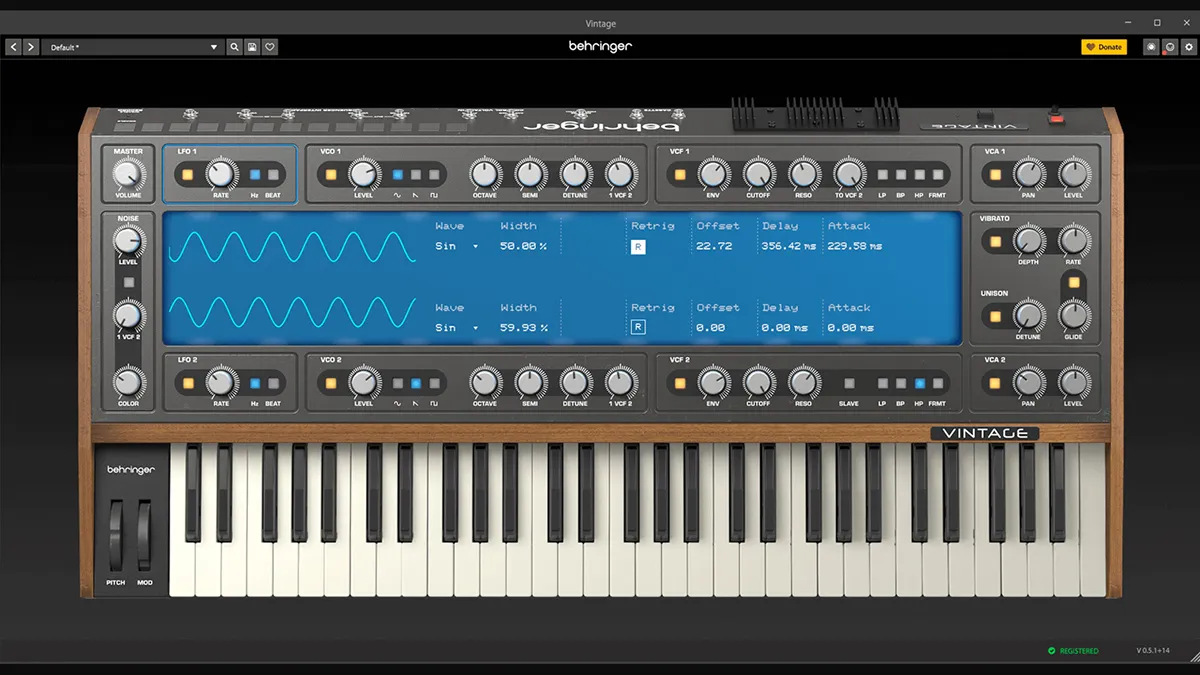
An Arturia ARP 2600 V soft synth
and an M-Audio Axiom 49 MIDI controller
helped Snaith come up with
ideas quickly, such as the thick layers
of metallic synths on “Kaili.” “I took the
part and made four layers of it, and
then I shifted over the second, third,
and fourth layers so that they’re all
happening at slightly different times,”
he says. “The second comes in slightly
after the first one, and the third one
comes in slightly after the second one,
etc. And then they’re all modulating
differently—maybe one of the filters is
turned down or has some weird
vibrato—going around your head, coming
in, fading to silence, and then coming
back in again.”
Miking is a simple proposition for
Snaith, with a borrowed Neumann TLM
103 for vocals and a Coles 4038 ribbon
mic as one drum overhead. But
although he recorded a lot of live
drums this time, most of the takes
didn’t make it to Swim, mainly because
he wanted to do something different
than he’d done on previous releases.
The ringing percussive sounds on
“Bowls” were created using just
that—bowls. “They’re these two
Tibetan singing bowls that I got
when I spent a month traveling
around southwest China last year,”
he says. “I picked them up, got them
home, and sampled them just once.
Then I mapped that sound onto a
keyboard and played it as if it were
a synthesizer.”
Meanwhile, the combination of pulsing
keyboards and crunchy drums on
“Found Out” was created with layers of
Fender Rhodes with a slow chorus
effect, organ, and orchestral percussion
samples meshed with a digital-sounding
distortion. And on “Odessa,” Snaith sampled
a bass note from an old musique
concrète record, mapped it onto the
Axiom, changed the decay, and played
the wobbly, bulbous bass part. “A lot of
the sounds on the record are some
hybrid of an acoustic sound treated as if
it were a synthesizer,” he says.
Although originally from Canada—
London, Ontario, to be exact—Snaith
now lives in the other London (England)
and mixed the album with UK
engineer David Wrench, as well as
Jeremy Greenspan (Junior Boys) back
in Hamilton, Canada.
This time, he wanted to create a mix
that was exciting, not perfect. “One
mix that I always come back to is the
Shuggie Otis album, Inspiration Information,
and the track ‘Island Letter,’”
Snaith says. “There’s a point where a
Fender Rhodes melody appears in one
ear, incredibly loud. Everything else is
so beautifully mixed and recorded and
sounds like you couldn’t even dream of
it sounding anymore lush. And then
that comes in totally out of the blue.
It’s weird moments like that, that
always captivate me and make me
excited about making music.”
Snaith describes his previous mixing
process (involving Mackie HR824 monitors)
as “messy, idiosyncratic, and
sloppy-sounding.” But he learned a lot
from Wrench and Greenspan. He also
made their job more difficult.
“I live on a main street, and there are
constantly big buses and trucks going
past the window,” Snaith says. “So all of
the vocal tracks have rumbling and
noises in the background, and then I
added an echo or a reverb. So when I
took these tracks to be mixed, I asked
Dave and Jeremy, ‘Is there anything
that I could have done to make the
parts easier for you to work with?’ And
they said, ‘Well, at least get rid of the
bus sound before you put the reverb on
it. Not only is there a bus on the
record, but there’s a big reverb’d bus
in the background.’”