Imagine a cast of 50 musicians spanning two countries, three recording studios and as
many engineers, a superstar producer, a Grammy-winning mix engineer, and a dazzling
acoustic guitar duo—it’s Rodrigo y Gabriela and C.U.B.A.’s Area 52. Any record
featuring the Mexican guitar slingers performing some of their most popular tracks
is reason enough to shell out cold, hard cash. But once Rodrigo Sánchez (lead guitar)
and Gabriela Quintero (rhythm guitar, percussion) joined forces with producer Peter
Asher and film composer Hans Zimmer, this project took on a life of its own.
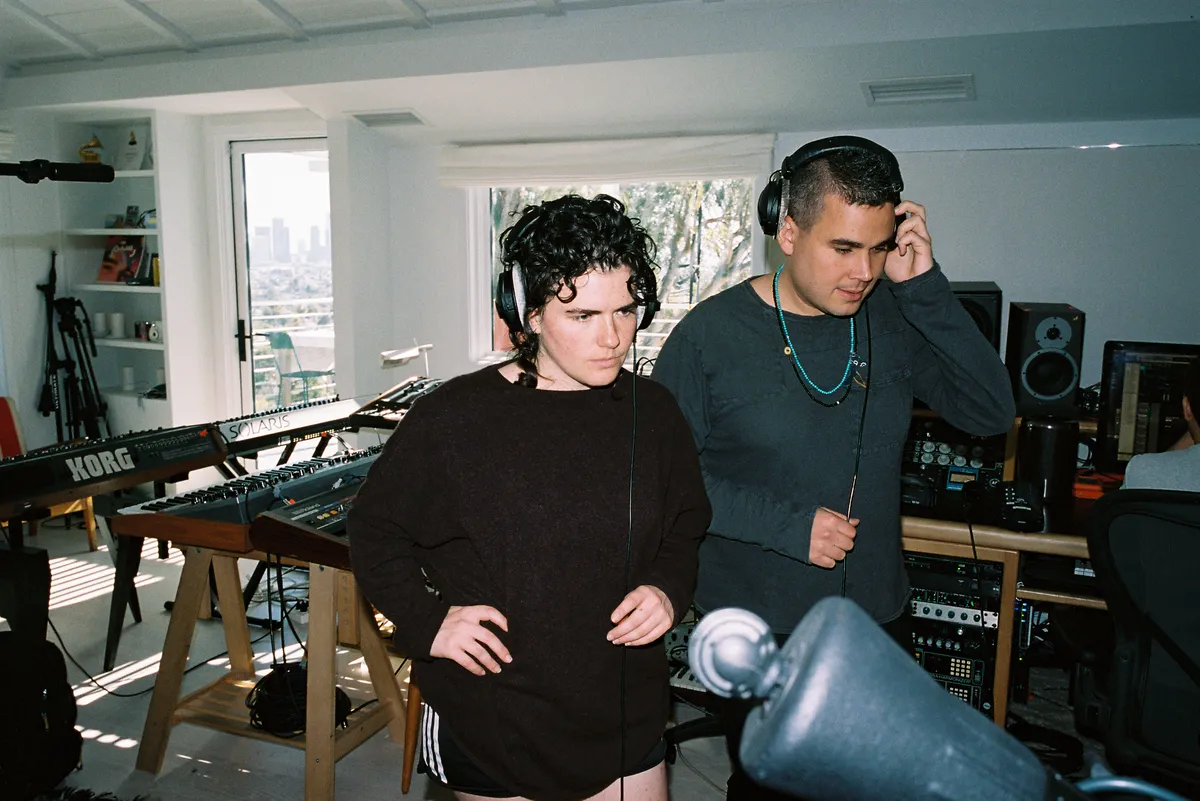
“The original idea was just to make a project in-between albums,” explains Sánchez from
L.A. “We thought, ‘Let’s put this out so we can take a break and the label will be at
peace with us.’ Then I had to come up with an idea! At the beginning we just laid down
tracks, then it grew as the label embraced the idea. Then we really got into the project.
We changed all the songs; it grew on us immensely. But it wasn’t planned this way.”
Like Moby Dick devouring a whale-ship of horrified sailors, Area 52 was the kind
of mammoth undertaking that could have
easily swallowed up lesser artists. Dial up any
track—“Santo Domingo,” “Master Maqui,” “Juan
Loco”—and the music is compelling, startling,
like a heavy-metal symphony for hardcore flamenco
kids. The duo’s custom-made Hermanos
Conde guitars race like the wind, brass shouts
and Latin percussion blasts assail the senses,
drum set rhythms whirl like El Diablo, and sensuous
strings tease the cerebral cortex. In true
Latin fashion, Area 52 is over the top, embracing
machismo and dazzling musicianship. And with
Peter Asher and Hans Zimmer onboard—both
of whom employed Sánchez and Quintero to
perform on the Puss in Boots and Pirates of the
Caribbean soundtracks—Area 52 merits a focused
technical dissection.
The recording logistics were challenging.
Sánchez and Quintero cut basic guitar tracks
at their Lumbini Studio in Ixtapa, Mexico.
The couple and their files were then flown to
Abdala Studios in Havana, Cuba, where the
music was played to the assembled rhythm
section/percussion ensemble/orchestra.
Once arrangements were fleshed out, and
translations sorted, Sánchez and Quintero
recorded scratch tracks with the rhythm section.
Percussion, brass, and strings were then
overdubbed. Finally, Sánchez and Quintero
re-tracked their parts back at Lumbini. Engineer
Rafa Sardina mixed the entire project at
his L.A. studio.
“We used DPA mics on the guitars,” Sánchez
says. “We experimented with different
positioning all the time. The best sound is not
right on the hole, because it sounds very boomy,
especially with these guitars. You should get in
between the last frets and the body. That is a
good position because you can get the full sound
for the guitar. For Gab’s guitar, you have to go all
the way to the end, where the bridge is. She’s a
different player, and she does a lot of body percussion
stuff. The playing is quite loud. We put
the mics probably 10 inches away. Especially
with Gab, she needs more room because [when]
her right hand moves, she feels uncomfortable
if the microphone is too close.”
Engineer Gabriel Benitez Herrera manned a
SSL Logic 4056 G+ console at Havana’s Abdala
Studios, one of the city’s most prestigious recording
environments. While Cuba continues to
suffer economically, you almost wouldn’t know
it here. Abdala’s equipment includes a Studer A
827, a slew of outboard and software processing,
and cherished mics from Neumann and Telefunken,
as well as AKG and Shure.
“It’s not state-of-the-art,” advises Asher, “but
they have some cool microphones and a full-on
Pro Tools system that worked, and that’s all
you need these days—along with a good room,
which it definitely had. We used their engineer,
who was terrific. Occasionally I would suggest
a different mic or position for a livelier sound.
They tend to record things close and dead, and
I am always trying to capture a bit of the actual
room, because we were in a really good-sounding
room and I like to get that on tape. They
tended to be on the safe side, maybe stick something
in an iso booth and mic it close. I would
say, ‘Let’s leave the door open and put a mic
outside as well.’ I was pushing for a bit more live
and a bit more room as an option.”
Like recording a soundtrack, or perhaps a
Broadway show with a cast of hundreds, Herrera
had his work cut out for him.
“With respect to how I manage the recordings
in such a large recording,” he stated (via
translator Paul Dryden), “I try to know in
advance [whether by phone or email] what it
is the artist wants to achieve with the process.
For example, what sort of musical style they
are looking to record and what format they’d
like to do it in. And at the base, I organize my
recording location. Even when you’ve done
these sorts of recordings plenty of times, each
one is completely different than the next, and
you have to be ready for adjusting once the
process actually begins.”
That left Peter Asher to act as de facto producer,
therapist, bottle-washer, and one-man
clean- up crew. Asher was the final voice, reediting
the arrangements into a cohesive whole.
“One of my biggest concerns about the whole
project was not to lose them,” Asher says. “We
had really brilliant Cuban arrangements and
amazing Cuban musicians who can wail away
and fill in all the percussion breaks and play
wonderfully, but we didn’t want to lose what this
album is all about, Rod and Gab’s playing and
their tunes, which people already knew. So part
of my duty as an advisor was to not lose Rod and
Gab in the mixture. We worked hard not to do
that. In the end we totally succeeded, it sounds
like a Rod and Gab album with all this cool instrumentation,
not the other way around. Every
time we rearranged something, that was my test,
my guideline. We wanted our stars out front and
center but kept the genius of what [arranger]
Alex [Wilson] and the musicians added.”
In the end, Sánchez and Quintero had the
final vote. And as concerned as they were
about pulling off this epic adventure of a recording,
it was still about maintaining their
identity, their style.
“I don’t know what our style is, and I am
happy I don’t know,” Sánchez laughs. “I try to
get rid of all the labels in my life and that’s a
difficult one. If I have something in my life that
doesn’t have a label, it’s the music we play. I’d
rather keep it that way.”
Read
interview extras and outtakes.