Print Page
A Modern Throwback
3/24/2011
On Stone Rollin’, Raphael Saadiq moves away from
a Motown sound to pay homage to broad influences
ranging from Sly Stone to Johnny Cash
by Jack Britton
Singer/songwriter/multi-instrumentalist/producer
Raphael Saadiq is living a pretty good life right now.
On a cold Thursday night in January, we find Saadiq
and his quintet (guitar, bass, drums, two singers)
sitting on stools under a dimly lit crystal chandelier
in a spacious suite on the 16th floor of San Francisco’s
classy Clift Hotel, breezily running through a
few tunes from his new album, Stone Rollin’. If
you’ve ever seen clips from Hugh Hefner’s late-’60s
TV series Playboy After Dark, which was shot on a
set made to look like a swinging bachelor’s penthouse
apartment, that’s what this room looks like.
And by the time Saadiq casually kicks into the
album’s first tune—“Heart Attack,” which he admits is
a nod to one of his idols, Sly Stone—the crowd of
about 75 local writers, music biz types, and a few
friends from his days across the bay in Oakland, is
well-lubricated and in a good mood. Just like
Saadiq. Handsome, relaxed, dressed head to toe in
black (including his trademark black-framed
glasses), and cradling a Telecaster on his lap,
Saadiq tells stories about his new songs and even
takes questions from the audience. The handful of
tunes he performs run the gamut from the rockabilly
shuffle “Daydreams” (inspired by Ray Charles and
Johnny Cash, he says) to traditional soul-flavored
tunes more reminiscent of his hugely popular 2008
album The Way I See It.
That disc, with its uncanny extrapolations on the
traditional mid-’60s Motown sound, created quite a
sensation and brought Saadiq a whole new
audience—mostly young, mostly white folks who
frankly were unaware of his long and illustrious history
dating back to the smash late ’80s, early ’90s Oakland
soul and new jack swing group Tony! Toni! Toné!;
the short-lived R&B supergroup Lucy Pearl (Saadiq,
En Vogue’s Dawn Morrison, and A Tribe Called
Quest’s Ali Shaheed Muhammad); and his solo
albums. No doubt many of the audiences who saw
him play huge festivals such as Bonnaroo, Outside
Lands, and Bumbershoot (he’s playing Coachella and
South By Southwest this year) thought he was a new
artist who’d just stepped off a bus from Detroit in
1965. The crowds ate it up—loved the tight-fitting
yellow suit he often wore, loved the Temptations
dance moves, loved that smooth, elastic voice that
moves so easily into Marvin Gaye/Eddie Kendricks
territory but still sounds original—and Europe and
Japan both fell in love with him, as well.
Of course the easy thing for an artist who is
clearly cresting and in-demand—when I interviewed
him a few days after the Clift event, our conversation
was interrupted by a call from Mick Jagger!—would be
to offer audiences more of the same sound they love.
But on Stone Rollin’, Saadiq has moved away from
the hard-core Motown sound and embraced a whole
new set of influences, like the ones mentioned above,
and also the more expansive orchestral sound of
post-Detroit Motown recordings and the great
Philadelphia soul records of the ’70s. It’s a more
eclectic album all the way around, but in the scope of
Saadiq’s whole career, just another synthesis of his
roots and current fascinations. After all, he first tackled
Motown-style songwriting with “The Tonys” (as he
calls them), and his first solo album was called Instant
Vintage. In short, this is what he’s been doing all
along, or as he puts it with a laugh, “You could say my
whole career is paying homage to everybody . . . but
I’ve still always got my sound.”
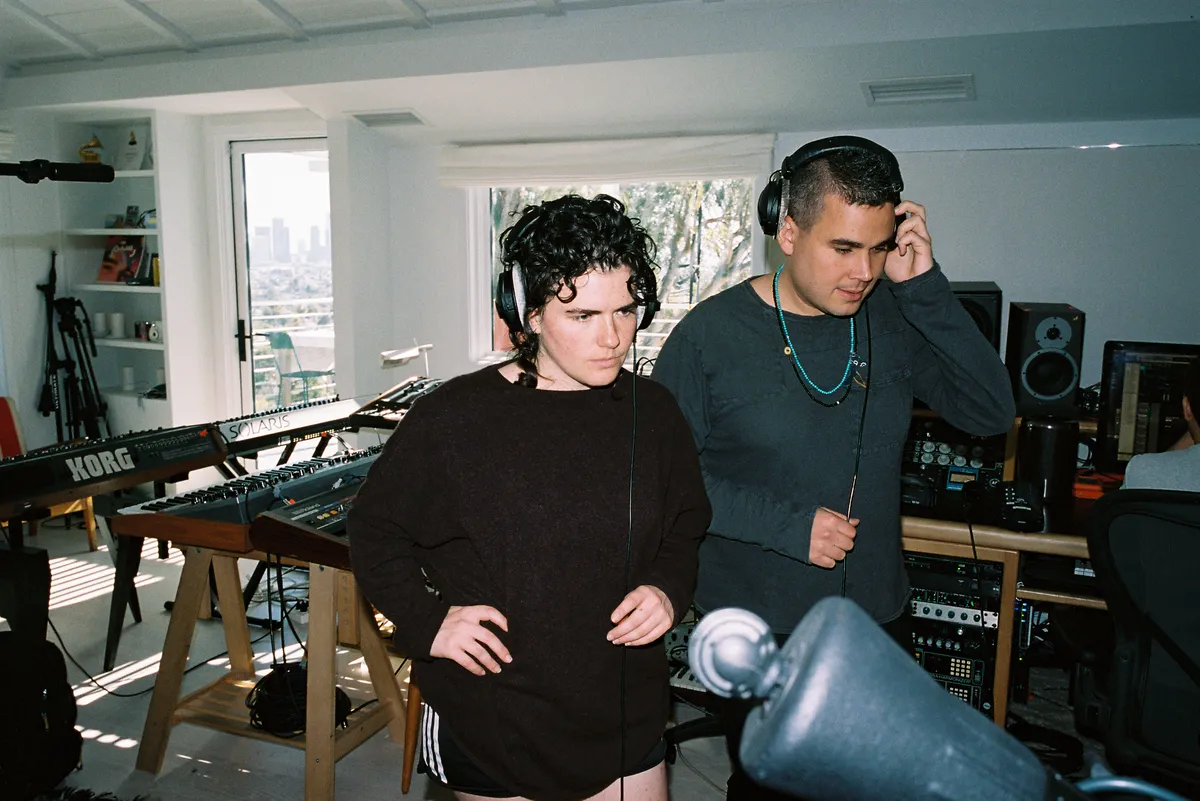
Engineer Charles Brungardt and Raphael Saadiq at Ocean Way Recording in Hollywood.
For the past several years, Saadiq’s principal
sonic partner has been an engineer named Chuck
Brungardt. Originally from Modesto, in California’s
Central Valley, Brungardt got a degree in computer
science from the University of San Francisco but fell
into the recording world. Working at a software
company by day, he also interned at Moulton Studios
in San Francisco for a period and eventually
“caught the ear of the producers Jake and the Phatman
[Glenn Standridge and Bobby Ozuma], and
they worked with Raphael a lot,” Brungardt explains.
“I ended up working with them for six months to a
year, and eventually, when I graduated college,
those guys were in L.A. a lot working on stuff with
Raphael at his studio. It was right when he finished the Ray Ray album [in 2004].”
Brungardt interned at Saadiq’s Blakeslee Studio
in North Hollywood and learned more about
engineering there from Standridge and Danny
Romero. When Standridge moved in to more of a
business role in his partnership with Ozuma (who
was mainly a writer/producer), Brungardt started
engineering more, and by 2007 Saadiq had
brought him onboard to help engineer and mix the
Introducing Joss Stone album, which Saadiq produced.
(Saadiq has a long production history, too,
having presided over his own albums since The
Tonys, and helming tracks by The Roots, Mary J.
Blige, The Isley Brothers, Macy Gray, Snoop Dogg,
D’Angelo, and many, many others; Brungardt
worked on a few of those, too.)
Saadiq and Brungardt obviously connect
strongly on a work level—Saadiq likes to layer multiple
instruments himself; he and Brungardt have
spent countless hours together in the studio, and
temperamentally, they are clearly suited to each
other. But another bond they share is their love of
collecting gear and musical instruments, and a fascination
with historic recording techniques. “I was
always into collecting gear on eBay, even back in
San Francisco,” Brungardt comments, “so we
started buying things like [Telefunken] V72 preamps
and old Ampex tape machines—we’d take the preamps
out of those and rack them up. Those kinds of
things helped us get closer to the sound we liked,
and we also studied the Recording the Beatles book, which was awesome. Those engineers really
knew what every piece of gear could do.”
“I love gear!” Saadiq adds. “Old keyboards, like
[Hohner] D6 clavinets, Hammond B-3s and trickedout
Leslies, old mics . . . I’m still collecting. I never
stop collecting. Guitars, basses . . . that’s part of
what keeps you making records. You have to have
the tools you need.”
“Before we did Joss’ album,” Brungardt notes,
“we are already playing with doing Raphael’s The
Way I See It, and the idea was, ‘Let’s buy old
equipment and make samples, and also let’s try to
make live playing sound like samples; maybe we’ll
put drum machine programming over it. Because
real players are more interesting and dynamic than
an 8-bar or 16-bar loop. After we’d worked on
Joss’ album and we got back to Raphael’s, we
wanted to take it in an ‘older’ direction, it became
almost like a bet with some of the guys who were
saying, ‘You can’t really re-create this old-sounding
stuff because the power-flow back then was
different, or the way this worked or that worked
was different.’ So Raphael and I just locked ourselves
in the studio and tried everything, from
bouncing tracks to a cassette tape to get that
noise—trying get it to sound dirty and old—to distorting
vocals in various ways, because they didn’t
have the compressors that we have now; they had
slower attacks. So that became part of the sound.
We had Motown books and we’d see pictures of
the guys in the studio and how their drums were
set up, how the mics were placed. So we started
out copying that, but as the process went on, we
sort of found our own sound within that: ‘Let’s try
to re-create that sound, but also modernize it by
making the bass heavier and the kick drums pretty
slammin’. It was a fun, experimental project.”
But it was not something they were interested in
repeating exactly on Stone Rollin’. “That last album
was a lot of fun to make,” Saadiq agrees. “Being in
the studio and miking things up in certain ways, and
studying up on the Motown EQs and all that, figuring
out exactly the right tone for that rhythm guitar
part. We spent hours on that stuff, and not just trying
to make it sound ‘old,’ but to put our stamp on it.
Chuck really goes to the wall for me when I’m
dreaming all this stuff up. He’s there going, ‘We can
do this! We can do this!’” he laughs.
Saadiq says that though The Way I See It
strongly reflects the Motown aesthetic, Stone Rollin’
is more in keeping with his other projects that have
drawn from more influences: “I’ve never shut my
ears to anything, really. It’s not like I’m always looking
for things, either, but I can’t close my ears to any
music. Any guitar, any drums, any rhythm section—
I’ve always been open to those things, trying to understand what makes them work in a song.”
Brungardt reveals that the move away from the
Motown sound “was kind of an accident. The first
time we recorded ‘Heart Attack’ was maybe six
months after The Way I See It, when he was taking
a break from touring. Originally it sounded more like
that record—it was more of a Motown shuffle. We
always loved the vocals, but we weren’t so set on
the music. At the same time, we started listening
back to the few songs we had when we went fullsteam
into this project and we both felt it wasn’t the
direction we wanted the next album to go. We
wanted to evolve the songs, and I wanted to evolve
the engineering, as well. On The Way I See It,
everything was pretty much tube pre’s and tube
compressors. On this one, I wanted to play around
with some of the more solid-state gear, like using
some Neve pre’s and EQs [1037s and 1272s] and
some Scully pre’s.
“Later, we revisited ‘Heart Attack’ and a lot of the
music we were listening to at that time was indie
rock—groups like Spoon and MGMT,” Brungardt
continues. “I loved the sound of those. In so much
R&B, people want it up-in-your-face and polished,
whereas indie rock was going the other direction.
They were looking back at some of the same
records Raphael was inspired by—Howlin’ Wolf and
Sly, and all that—and taking elements from them and
using them in different ways. So I was trying to push
Raphael to be a little more gritty with guitars and
use a little more distortion.”
“Heart Attack” is one of several songs on Stone
Rollin’ that feature Saadiq playing nearly all of the
instruments. “I feel pretty comfortable playing whatever’s
in front on me,” he
comments, “though live, I
guess I’m most comfortable
playing bass [his main
instrument for many years]
or guitar. On ‘Heart Attack,’
the drums came first, then
I’d do guitar, lay the bass,
one part at a time.” In the
case of that tune, everything
but the original vocal
and some of the drums
were stripped when Saadiq
decided to take the song in
a different direction, and
then he rebuilt the parts.
Since he’s often recording
one instrument at a
time, Brungardt is able to
use one or both of his
beloved Neumann U47s on
almost everything. “I use it as a mono overhead, I use it on guitar; if we did a
bass amp, I’d use a 47 as well,” he says. The
process of layering to a create a basic track can be
quite fast—literally just a few minutes per part—or
take several hours. More complicated parts and
solos generally take more time and involve greater
experimentation. Saadiq likes to record his vocals
alone in the control room, and uses a dynamic mic,
usually Shures. “This was something Gerry Brown
pushed him to use back in the Instant Vintage and
Tonys days,” says Brungardt. “His voice benefits
from a dynamic mic because it tends to give him
more bottom and presence. Plus dynamic mics can
sound a little older when pushed.”
Among Brungardt’s other favorite techniques to
get Saadiq’s characteristic sound is cranking the
gain on a Fender Twin to get more distortion. “One
of my favorite plug-ins is Tapehead [by Massey], and
I’ll use that on a lot of things to get a little more grit,”
he adds. “It thickens stuff up nicely if you record
something that’s a little too bright. I usually go a lot
for darker tones when recording and mixing. Another
thing we like to do is re-amp guitar parts. He’ll go
through one of those Avalon DIs, and we’ll take that
signal and re-amp it through a ’67 Twin, or on some
songs we’ve used an older Vox AC-30. Some of the
songs even used Amp Farm: He might use that if
he’s just trying to get an idea down quickly. Then, if
it’s something he really likes, we’ll go back and
clean it up and re-amp it.”
Orchestral sessions took place in Ocean Way’s Studio B.
On the new album, Brungardt used a McDSP
FilterBank plug-in to deal with excessive high end in
spots, as well as the Waves Renaissance EQ, and
though he is a fan of the Line 6 Echo Farm, for this project, he turned to an Echoplex clone. He also
utilized a Roland Space Echo during mixing, which
was done on the SSL 9000 in Blakeslee’s “C”
room. (The album was cut to Pro Tools in Blakeslee
Studio A, using the SSL 4000 Series desk mostly
for monitoring.)
One of the most striking features of Stone Rollin’
is the lush orchestrations that appear on several
songs. Saadiq has always had a fondness for
strings, but rarely have they been featured so prominently.
“Instead of just having a string section off in
the background,” he explains, “I wanted on certain
songs for the strings to be more expressive, so I
talked to [arranger] Paul Riser about the titles and
what I was going for in the songs. I’d say, ‘For this
word, I want it to be orchestrated this way. When I
listen to the song “Go to Hell,” I want to hear the
winds in the valley rushing into me.’”
What are his orchestral influences? “Just music;
music of all kinds. There are a lot of orchestral
arrangements in dance music. And also from
watching cartoons! There are a lot of orchestras in
animation. I just thought [the orchestrations] would
fit well with some of the new songs I was doing.”
The orchestral dates took place at Ocean Way
Studio B in L.A., with Gerry “The Governor” Brown
engineering—Brown has worked with Saadiq on
projects dating back to The Tonys, and Brungardt
volunteers that he has learned much from him
through the years. Brown also did some tracking
with Saadiq at Blakeslee when Brungardt was off
doing work for the videogame company he and
Saadiq run, called Illfonic (whose games include
Ghetto Golf and the first-person shooter Nexuiz).
The horns were mostly done at Blakeslee, too.
A few tracks feature musicians from Saadiq’s
band, such as drummer Lemar Carter, bassist Calvin
Turner, and guitarist Rob Bacon. And there are also
a few guests, such as steel-guitar wizard Robert
Randolph, former George Clinton associate “Amp”
Fiddler (the song “Go to Hell” began with one of his
Mellotron ideas), guitarist Wah-Wah Watson, and
Earth, Wind & Fire keyboardist Larry Dunn.
But mostly, it’s the versatile Saadiq, layin’ every
part down with authority and finesse. “I know I’m
lucky,” he says. “I get to dream and create things
and work in the studio, and then I get to go out and
watch people enjoy it.”
Print Page