Standing in the shadows of Disneyland is the Anaheim
Convention Center, home of the Winter NAMM show. This year’s
show, which took place from January 15-18, was a pretty typical NAMM
experience. Musical instrument and gear manufacturers showed off their
latest wares, while music-store buyers, the press, and a gaggle of
music celebs cruised the floor, looking for cool new gear and
schmoozing up a storm.
From a business standpoint, the unofficial take on this year’s
show was that it was a busy and successful one. For recording
musicians, there were plenty of interesting new products of many
varieties, but computer-related products—such as
soft-instruments, effects plug-ins, sounds, and audio
interfaces—were particularly prevalent. Here are some of the
highlights from the show, arranged by category.
Software and Sounds
Apple announced a complete
revamping of the Emagic Logic line of digital audio sequencers. There
will now be only two titles in the line: Logic Pro 6 ($999),
which bundles Logic Platinum with the Emagic’s full line of
plug-ins and software instruments; and Logic Express ($299). The
latter offers less features than its big brother, but still provides
plenty of functionality. The Apple booth was also packed for its demos
of Garage Band, the new, budget-priced music production program.
Garage Band is part of Apple’s new iLife ’04 suite
($49) that the company announced at the recent MacWorld Expo in San
Francisco.
|
|
ARTURIA
MiniMoog V
|
Arturia will be releasing a new
soft synth, MiniMoog V ($199), which offers a complete emulation
of the classic MiniMoog synth. You get features from the original such
as voltage-controlled oscillators, a 24 dB-per-octave resonant filter,
an external audio input, and two ADSR Envelope Generators. Arturia has
also added some features of its own including a Modulation Matrix, a
tempo-synchonizable LFO and arpeggiator, and chorus and delay effects.
Arturia also announced the release of Storm 3.0 ($149), the
virtual studio program. New features will include an unlimited number
instruments and effects (limited only by processor power), an
audio/MIDI sequencer, new mixing features, a piano-roll display, a new
GM sound module and more. Storm 3.0 will ship in March.
The big news at BIAS is the soon-to-be-introduced Peak
4.1 ($499 for the full version, upgrade price varies depending on
the version you own). The 2-track editor for Mac OS X will incorporate
Roxio’s Jam software for CD burning, and SFX Machine LT, a
“light” version of the sound design/effects plug-in.
Big
Fish Audio introduced the new ignition v.i. series of
8-track, REX 2 player plug-ins from eLab. Three
titles are scheduled: Obsession ($299.95), aimed at Hip-Hop,
R&B, and pop producers; Foundation ($299.95), aimed at
Old-School Hip Hop and R&B producers; and Perfection
($299.95), aimed at House producers. The players are plug-ins for Audio
Units and VSTi, and will run on Mac OS X and Windows XP. All three
collections come on DVD, include 3 GB of loops and samples, and are
scheduled to ship in the second quarter of 2004.
Celemony
Software announced Melodyne uno ($150), a light
version of its Melodyne pitch-and time-shifting software. Melodyne
uno—which runs on both the Windows XP and Mac OS X
platforms—is designed as a mono audio-editing tool that you can
use to alter pitch and timing. It runs as a VST, Audio Unit, RTAS, or
Direct X plug-in, or through ReWire. Melodyne uno is scheduled to ship
in April.
Cycling
’74 was showing new versions of M (v 2.6),
its intelligent composition and performance software, and the
plug-in bundle Pluggo (v. 3.1). The latter now supports VST,
Audio Units, and RTAS. The company also unveiled a new suite of
plug-ins called the Mode Bundle ($199). It contains three
virtual synths: Poly, Mono, and Bang; and two effects plug-ins: Spin
and Wash.
Discrete Drums had a couple cool
new sound sets on display. Earthbeat ($189), is a collection of
world-music percussion loops that’s due out in mid-February.
Discrete Percussion: The Eric Darken Collection ($99), is a
collection of unusual—but heavily grooving—percussion
loops, and is due out in late February. It features such instruments as
the attaché case latch, the laundry basket, and the shower
curtain.
People who visited the Ilio booth were raving about
Ivory ($349), a grand-piano virtual instrument from Synthogy.
Ivory is compatible with AU, RTAS, and VST 2.0 (Windows support is
slated for later this year.), and comes with more than 20 GB of piano
sounds including a German Steinway D 9' Concert Grand, a
Bösendorfer 290, an Imperial Grand, and a Yamaha C7 Grand.
Ivory’s sample-playback engine offers 32-bit playback and
built-in effects such as chorus, “real ambience,” and
EQ.
One could say that Digidesign dropped a bit of a
“bombshell” at the show, when it announced that it had
purchased the assets of Bomb Factory Digital, a developer of Pro Tools
plug-ins that specialized in emulations of classic signal processing
gear. According to Digi’s David Lebolt, “Our acquisition of
Bomb Factory underscores Digidesign’s commitment to deliver the
most powerful creative options available to Pro Tools
customers.”
|
|
Korg Legacy
Collection
|
One of the most exciting and impressive software introductions of
the show came from Korg, which was demonstrating the Legacy
Collection ($625) for Mac OS X and Windows XP. It’s comprised
of a suite of soft synths (that run either as standalone instruments or
VST plug-ins) designed to emulate Korg’s classic MS-20, Polysix,
and Wavestation synths. What’s more, the bundle, which will be
available in April, also comes with the MS-20iC, a 3/4-scale
replica of the MS-20 that’s not a synth in itself, but is a
working USB/MIDI controller that can control all the functions of the
MS-20 soft synth.
Over at the MOTU booth, the big news was the imminent
release of the OS X version of the Editor/Librarian Unisyn.
It’s expected out any day now.
Although the new VS8F-3 Plug-In Effect Expansion Board ($395)
from Roland isn’t software per
se, its announcement is one of the biggest software developments of the
show. Why? Because it will allow users of Roland VS workstations to use
effects plug-ins from a host of third-party developers including
Antares [www.antarestech.com], Cakewalk,
IK
Multimedia, Massenberg Design Works, McDsp,
Sound
Toys, TC Electronic, and Universal
Audio. Roland expects the board to be available by the end
of January.
Steinberg was showing a new
hardware/software bundle called Cubase System 4 ($499) for Mac
OS X and Windows 2000, XP Home and XP Professional. Due to ship in
February, it will include the 4x4 MT4 USB-audio interface and Cubase SL
software.
|
|
Tascam
GigaStudio 3.0
|
One of the more important software announcements at the show came
from Tascam, which revealed the impending
release of GigaStudio 3, an updated version of its heralded
soft-sampler. It will come in three versions: Orchestra ($599),
Ensemble ($369), and Solo ($199). According to Tascam,
GigaStudio 3 has been rewritten “from the ground up,” and
will offer such features as 96kHz/24-bit sample support, ReWire
support, and VST plug-in support. It will also include GigaPulse,
Tascam’s convolution reverb processor. (The SP version of
GigaPulse will come with Ensemble and Solo, the Pro version with
Orchestra). A spokesperson for Tascam said that the company will offer
upgrade options for registered GigaSampler users, but those prices have
yet to be determined.
TC Electronic caused a stir with its new Virus|PowerCore
($499), a software version of the Access Virus synth for TC’s
Powercore platform. Available in March, the new instrument will run as
a VST instrument for Windows and Mac, and as an Audio Unit plug-in
under Mac OS X.
|
|
Waves
IR-1
|
Waves debuted an impressive convolution
processor called the IR-1 Parametric Convolution Reverb ($800
native, $1200 TDM). The IR-1 features a variety of sampled acoustic
spaces including the Sydney Opera House, the Ryman Auditorium in
Nashville (the original Grand Ole Opry venue), The Bottom Line (the
recently closed NYC nightclub), The Knitting Factory, Signet Sound
Studio A, Westlake Audio Studio D, and even the interior of a Lincoln
Navigator. Waves also unveiled the Musician’s Bundle
($199), which includes five Waves’ plug-ins: Renaissance Axx,
Super Tap, Renaissance Vox, Doubler, and MetaFlanger.
Yamaha jumped into the plug-in fray with
three new VST titles: Pitch Fix ($299), a pitch-correction and
pitch-shifting plug-in; Vocal Rack ($199), a vocal processor
that offers high-pass filtering, compression, an enhancer, a three-band
EQ, a de-esser, and more; and Final Master ($199), which
provides audio mastering tools such as multi-band compression.
|
|
Zero-G
Lola
|
The most stunning software demo at the show had to be of the new
Vocaloid software applications from Zero-G
(distributed by EastWest). Using technology licensed from
Yamaha, Zero-G, is about to start shipping two “virtual
vocalist” programs, Leon ($329.95) and Lola ($329),
which were put together from the recorded voices of a pair of London
studio singers and a whole lot of computer code. The software generates
relatively realistic-sounding synthesized vocals. The notes for the
vocal parts (up to 16 parts can run at a time) are manually entered
into a piano-roll-style sequencer and can be edited to add expression
such as vibrato, crescendo and diminuendo, and much more. The lyrics
are entered in by typing the words into a text box over the
corresponding notes. The software runs on Windows XP or 2000 (a Zero-G
spokesman said that a Mac version will probably be available later this
year), and can be used as a standalone application or as a VST or
ReWire plug-in. A third title—Miriam—will be
released in March.
Mixers, Monitors, and Multitracks
One of the most notable of many product introductions from
Behringer was the SL3242FX-PRO
($629), a 32-input, 4-bus mixer with built-in effects. It sports a pair
of 24-bit stereo effects processors, a 9-band stereo graphic EQ, 4 aux
sends per channel, an integrated talkback system, as well as
solo-in-place and pre-facer listen features. A 24-input version, the
SL2442FX-PRO ($499) was also shown. Both mixers are due to ship
in the first quarter of 2004.
|
|
KRK
Rokit5
|
KRK introduced its Rokit line, a
value-priced series of active studio monitors. Models include the
RP5 ($598/pair), which features a 53 Hz to 20 kHz frequency
response; 75W of power; a 5-inch woofer; a 1” Neodymium tweeter;
and XLR, 1/4-inch, and RCA inputs. Other models in the line include the
RP6 ($798/pair), the RP8 ($998/pair) and the RP10S
($599.99) powered sub. KRK also announced its V Series 2, an
upgrade to its V Series monitor line.
|
|
Mackie Big
Knob
|
Mackie
was showing off its new Onyx line of mixers, which includes three
models of FireWire-capable, 4-bus, analog boards. All three, the
Onyx 1220 ($639), the Onyx 1620 ($919), and the Onyx
1640 ($1539.99) can be paired with an optional FireWire card
($499.99) that offers flexible I/O functions. The Onyx products are
scheduled to begin shipping in the second quarter of 2004. Another
interesting product at the Mackie booth was Big Knob ($384.99),
a “studio command” device that was designed to provide a
variety of control-room functions that DAW-based studios without
outboard consoles are often missing. Big Knob, gives you monitor
switching, talkback, input source select for up to four different
stereo sources, two headphone outs, and more.
Along similar lines was the Central Station Studio Control
Center ($699), which was being shown by PreSonus.
Due to ship in February, the 1U rackmount unit lets you switch between
three sets of monitors, and it offers three sets of stereo analog
inputs, digital inputs, and two headphone outs. According to PreSonus,
the unit’s purely passive signal path will eliminate coloration,
distortion, and noise, giving the user “transparent sonic
quality.”
|
|
Roland
VS2000cd
|
Over at the Roland booth, two new multitracks were on
display. The VS-2000CD ($2,395) is the newest model in the
company’s popular VS series. Due to ship sometime in February,
the unit gives you 20 recording tracks, a 40 GB hard drive, eight XLR
inputs, a CD-RW drive, a 40-channel digital mixer, 4-band EQ for any
input or track, and much more. In the Boss section
of the booth was the BR-1600CD ($1,595), which can record 8
simultaneous tracks and playback 16. Its features include a 40 GB hard
drive, eight phantom-powered XLR inputs, 3-band EQ, and COSM modeling
effects.
|
|
Soundcraft
Compact 4 and Compact 10
|
Soundcraft
is about to release two new mixers that are designed especially for
use in computer-based recording. The Compact 4 ($149), offers 2
XLR mic inputs with 48V phantom power, and 2 stereo line inputs
sporting both 1/4-inch and RCA inputs. The Compact 10 ($299) has
4 XLR mic inputs (the phantom power is switchable in groups of 2) and 6
stereo line channels (4 with 1/4-inch and RCA inputs, and two with RCA
inputs only). Both mixers offer dual headphone outs with separate
mixes, and are designed to mix the live recorded sound with the
computer’s output for zero-latency monitoring.
Tascam made a big splash with a personal
digital studio of its own, the 2488 ($1,499). Available in
February, the 2488 gives you 24-tracks of 24-bit audio, 250 virtual
tracks, 36 mixer channels, 3-band EQ for each of the 24 tracks, a
built-in CD-RW drive, 4 XLR inputs with phantom power, four 1/4-inch
mic/line inputs, a 64-voice General MIDI sound module, and more.
|
|
ZOOM
MRS-1608
|
Yet another entrant in the personal digital studio sweepstakes was
Zoom, which introduced the MRS-1608
($1749). This 16-track unit (8 tracks simultaneous record and 16 tracks
simultaneous playback) comes with a 40 GB hard drive, 8 XLR inputs (4
with phantom power), digital effects, guitar-amp modeling and more. Two
of its coolest features are the programmable drum and bass sections,
which don’t use up audio tracks, and feature touch-sensitive pads
for programming. You can also opt for the MRS-1608CD ($2,099),
which comes with an built-in CD-R/RW drive.
Keyboards, Synths, and Audio Interfaces
Alesis introduced the Micron
($699), which contains the same analog-modeling engine as the
company’s Ion synth. A partial list of Micron’s features
include a 37-key keyboard, a programmable step sequencer and
arpeggiator, stereo effects such as vocoders and reverb, and four
multitimbral parts.
Dave Smith Instruments were showing the
Poly Evolver ($1,395), a 1U rackmount module that offers
four-voice operation, making it the functional equivalent of 4 of the
original Evolvers. Due out in April, the Poly Evolver can be edited
with free editor software (Mac OS 9, OS X; and PC) available on the
company’s Web site. The synth offers such features as two analog
and two digital oscillators, FM and ring modulation on the digital
oscillators, four LFOs, 3-tap delay that syncs to MIDI, a 16 x 4
analog-type sequencer, and much more.
Echo
Audio was showing its Echofire series of FireWire audio
interfaces, which comprises three different units. The top of the line
is the Echofire 12HD ($TBD), which offers 12 +4 dBu XLR ins and
outs; 24-bit,192 kHz sampling rates; and word-clock sync. Next is the
Echofire 8 ($999), which gives you 4 XLR/1/4-inch combo jacks, 4
1/4-inch TRS outputs, MIDI In and Out, word-clock sync, and S/PDIF in
and out. Finally, there’s the Echofire 2 ($499), featuring two
XLR/1/4-inch combo jacks, 6 1/4-inch TRS outputs, trim controls, and a
headphone output. Echo expects all three to ship in April.
|
|
Edirol
PCR-1
|
Edirol debuted the PCR-1 ($370), a
low-profile keyboard controller and audio interface. It has 25
cut-down-but-quite-playable, velocity-sensitive keys; is only 1
3/16-inches tall; and weighs less than 3 pounds. On the audio side, it
offers stereo RCA input/outputs and a stereo 1/8-inch jack that does
double-duty as an S/PDIF output. The PCR-1 is USB-bus powered, offers
16 control-map memory locations, and its drivers support Windows XP and
Mac OS X. Edirol also was showing a new FireWire audio interface, the
FA-101 ($695). Available in April, the 10-in, 10-out unit
supports audio up to 24-bit, 96 kHz on both the Mac (CoreAudio) and PC
(ASIO 2.0, WDM).
|
|
Elektron
Monomachine
|
Although it didn’t have a booth, Elecktron
was showing the Monomachine ($1950) in a nearby hotel suite, and
those who saw the demo said it was extremely cool. The Monomachine
offers six different mono synths, a six-track internal sequencer, six
audio outs and two audio ins, a three-octave velocity-sensitive
keyboard, a joystick, and much more. Also available is the
SFX-60 ($1,300) a table-top module version. The Monomachine is
distributed in the USA by GSF agency.
E-mu debuted three new
digital-audio recording systems for Windows XP and 2000: the
1820M ($499), the 1820 ($399), and the 1212M
($199). The systems feature different combinations of PCI cards and
breakout boxes, offering FireWire, S/PDIF, and ADAT digital I/O. The
1820M and the 1212M feature “mastering grade” A/D
converters (the same as used in Digidesign’s Pro Tools HD
systems), and all three offer a DSP multi-effects processor that allows
up to 16 simultaneous effects without using up computer CPU
resources.
Korg was showing the Triton
Extreme, a new version of its Triton workstation and sampler. Available
in April, the new Triton will come in three flavors: the Triton
Extreme 61 ($2,800), which offers 61 synth-action keys; the
Triton Extreme 76 ($3,150), which gives you 76 synth-action
keys; and the Triton Extreme 88 ($3,600), sporting 88 keys with
“progressive graded hammer action.” All three units feature
1,334 programs, 1280 combinations, 50 drum kits, 120-note polyphony,
sampling and resampling to CompactFlash cards, a USB output for storing
sounds, and much more. Perhaps the most unusual aspect of Triton
Extreme is the 12AU7 tube that can be used as an insert effect or
strapped across the main output.
One of the more interesting keyboards at the show was the
Keystation Pro 88 ($TBA) that M-Audio
displayed at its booth. It’s an 88-key, weighted-action,
USB-bus-powered keyboard controller that has 4 zones and a multitude of
assignable MIDI controllers including 9 faders, 24 rotary controllers
and 22 buttons. The unit not expected out until the second quarter of
the year, but assuming it follows M-Audio’s tradition of
aggressive pricing, it’s a product to look out for in the
future.
Moog introduced the Etherwave Pro
($995), a striking-looking theremin made of Birdseye Maple. The
instrument gives you a 6.5 octave range, control-voltage outputs, tuner
outputs, and a headphone output. It’s due to ship at the end of
March.
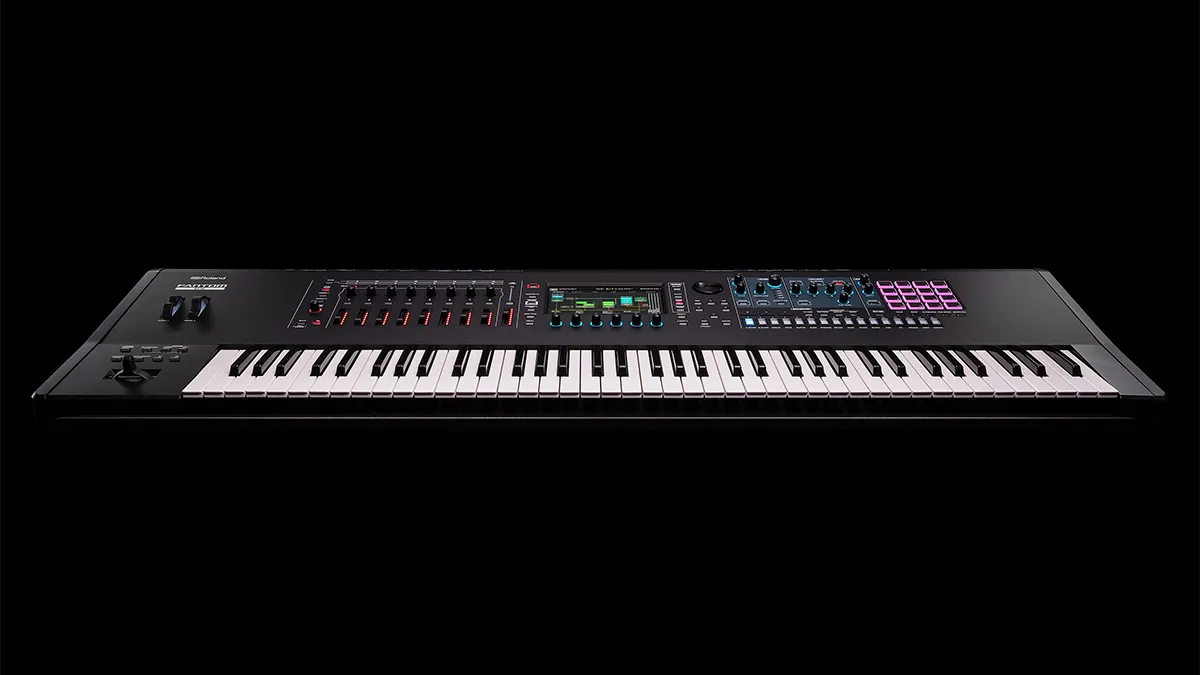
One of the many Roland product introductions was the new
Fantom-X series of workstation keyboards. The new line includes three
models: the 61-key Fantom-X6 ($2,395), the 76-key
Fantom-X7 ($2,895), and the 88-key, “progressive
hammer-action” Fantom-X8 ($3,395). All three models offer
128-voice polyphony, 128MB of internal wave ROM, and can hold up to 544
MB of sample RAM using optional DIMMs. The keyboards all have a USB
port, as well as a suite of onboard effects including COSM Guitar Amp
Modeling, Lo-Fi Processing, and a mastering processor. Roland also
announced the Fantom-XR ($1,595), a 1U rackmount module that
uses the same sound engine as the Fantom keyboards; and comes with 128
MB of internal ROM, 16 MB of sample RAM, a USB port and more. Roland
expects the keyboards to be available in March and the module in
April.
Mics, Preamps and Processors
Audio-Technica debuted its new,
affordable, small-diaphragm condenser mic, the MB4k ($129). Part
of its new Midnight Blue line of mics, the MB4k features a cardioid
pattern, and can run on either batteries or phantom power.
Meanwhile, Audix was showing its new i5($179),
a cardioid dynamic that’s designed for instrument-miking
applications. The mic has a frequency range of 50 Hz to 16 kHz, and can
handle sound pressure levels up to 140 dB.
Blue
Microphones displayed a prototype of its new 8-Ball
($279), a softball-sized condenser mic that follows in the footsteps of
the Ball, the company’s spheroid, phantom-powered dynamic mic.
Blue expects to roll out the 8-Ball sometime in April.
CAD is reintroducing its Equitek
line of mics, and the first revamped model to be released is the
E1002($399), a supercardioid electret condenser. Able
to withstand up to 148 SPL (with its pad on), CAD recommends the
E1002 for a wide range of miking applications including
percussion, strings, and vocals.
|
|
DigiTech
GNX-4
|
DigiTech was showing its latest GNX
processor, the GNX-4 ($799). The unit is a combination of guitar
multi-effects, modeling processor, USB-audio interface, and multitrack
recorder. It includes an 8-track digital recorder (which uses
CompactFlash memory for storage), 15 guitar-amp and 10 bass-amp models,
Distortion-Stompbox Modeling, a MIDI drum machine, XLR and 1/4-inch
outputs, USB output, and a mic input with phantom power, and recording
software for Mac and PC. DigiTech also introduced The Weapon
(149.95) a stomp box that recreates seven of Disturbed guitarist Dan
Donegan’s favorite studio tones from songs such as “Down
with the Sickness,” “Mistress,” and
“Stupify.” The presets include a mixture of effects such as
Whammy, dynamic autowah, pitch shifting, and reverb. The technology
used in the Weapon will allow DigiTech to recreate the tones of other
famous guitarists in subsequent pedals.
One of many new products at the M-Audio booth was the Octane
($749.95), a new 8-channel mic preamp. Each channel offers balanced XLR
and 1/4-inch TRS inputs, and there are two 1/4-inch TS instrument
inputs on the front panel for channels 1 and 2. The XLR inputs have 48V
phantom power, which is switchable for channels 1-4 and 5-8. The Octane
also features an ADAT Lightpipe output, which can be used to connect
the unit to audio interfaces, ADATs, and digital mixers.
To go along with the three mixers introduced in its Onyx line (see
“Mixers, Monitors, and Multitracks”) Mackie also
unveiled the Onyx 800R ($1279.99), an 8-channel mic preamp with
AES/EBU, ADAT Lightpipe, and S/PDIF digital outputs. Other features
include eight XLR inputs with individually switchable phantom power,
two front-panel instrument inputs, and individual phase and low-cut
switches.
|
|
Moog MF105
MURF
|
Fans of the Moogerfooger processors from Moog, will
be glad to know that the company has added a new model, the MF-105
MURF ($435). MURF, an acronym for Multiple Resonance Filter Array,
aptly describes the pedal, which is equipped with eight filters, each
controlled by its own sliders. The filter levels can be animated using
one of 24 adjustable-rate preset patterns, and there’s a Tap
Tempo Input that accepts an external footswitch.
Nady
Systems was showing a prototype the RSM-2, a ribbon
condenser that’s tentatively priced at what would be an
astoundingly low price for a ribbon mic, $439. We’ll have to wait
and see when this mic is actually released, and what kind of a sound it
has, but it’s a promising development from a price
standpoint.
Miscellaneous Hardware
Ebtech displayed its recently released
hum-eliminating product, the Hum-X ($90). Designed to eliminate
ground loops, the Hum-X is simple to use. Plug the piece of gear with
the ground loop into the Hum-X, and then plug the Hum-X into the wall.
According to Ebtech, your ground loop will then be safely and
effectively eliminated, and your audio signal will be unaffected.
|
|
EZDupe
EZD9168
|
EZDupe was touting its new EZD9168
Portable Compact Disc Duplicator ($549), an extremely lightweight,
one-to-one standalone CD duplicator. The unit can also connect to a
computer (Mac or Windows) and function as a CD-R drive.
Furman announced new versions of its
PL-Plus and PL-8 power conditioners. The PL-Plus Series II
($249.95), and the PL-8 Series II ($189.95) offer a host of
improvements including “non-sacrificial” circuitry, which
means that if a power surge is encountered, the internal circuitry of
the power conditioner isn’t damaged.
LR
Baggs introduced the M1 ($199), a natural-sounding
magnetic pickup for acoustic guitar. The M1 could be useful in
recording situations in which there’s no isolation between the
acoustic guitar and the rest of the band, or when a mic/pickup
combination is used. According to the company, the secret to the new
pickup’s sound is its TriAxial Dynamic Technology, which allows
the M1 to pickup not only string vibrations, but body vibrations, as
well.
Peterson unveiled its new
StroboStomp ($309), a stompbox tuner and DI that uses the
company’s Virtual Strobe Technolgy. According to a Peterson
spokesperson, the StroboStomp should ship in April.
Ultrasone was showing updated versions of
two of its headphone models including the HFI-650 ($249.00;
PROline model $299.00), and the HFI-550 ($189.00; PROline model
$239.00). Ultrasone’s headphones utilize the company’s
S-Logic Natural Surround Sound technology, designed to give listeners
the sense that the music is playing outside of their heads rather than
in it. In addition, the company claims that the technology reduces ear
fatigue by lowering the dB output by 40% (compared to standard
headphones), without changing the perceived loudness level. Ultrasone
headphones also reduce magnetic field emissions, but if you purchase
its PROline models, the reductions are even greater.