Print Page
The Ting Tings Make a Playlist
3/14/2012
Nearly four years have passed between the
original U.K. release of the Ting Tings’ worldwide
breakthrough debut album
We Started
Nothing and the appearance of
Sounds From
Nowheresville, the duo’s wildly eclectic followup.
During that time, Jules De Martino and
Katie White nearly called it quits before relocating
their mojo on an MP3 player. The only
way to understand what was at stake for them
is to go back to the beginning.
The pair’s previous group, the trio Dear
Eskiimo, was dropped by Mercury U.K. in late
2005 after they’d spent a year in the studio.
Shell-shocked and embittered, White and De
Martino returned to Islington Mill, an artists’
conclave in the Manchester borough of Salford,
where they’d been living and working on the
scrapped record. They took day jobs, and in
their free time De Martino painted while White
designed clothing. They started throwing parties
where their artist friends gathered to smoke
weed, have a laugh, and blast the records they
loved—Talking Heads, Prince, the Smiths—
with everybody taking turns as DJ. In time,
these gatherings grew into organized events
that became a major attraction for hipsters.
“Slowly, that turned into a creative process,”
De Martino says of their club nights.
“We started to write some songs and perform
them at the parties. We put a drum kit on the
little stage and I’d play records and drum along
to them. Then I started creating loops on my
loop pedal, and one day Katie picked up my guitar—
she’d never played before. That moment was
really the pair of us having gained the confidence
to say, ‘Have we just become a band again?”
They had indeed. With everything the newly
named Ting Tings wrote and recorded, “the
attitude was based on spontaneity,” De Martino
explains. The tracks they were coming up with
were not only infectiously in-your-face but also
absolutely distinctive; no wonder A&R reps
started coming to their parties. In late 2007 the
duo signed with Columbia, which released their
defiantly DIY We Started Nothing in Britain the
following May. The partners weren’t prepared
for what happened next, as their little art project
resulted in a chart-topping U.K. album and
single, “That’s Not My Name.” They wound up
selling two million albums worldwide. They’d
become pop stars by accident.
“When we first started the band, we didn’t
anticipate being successful,” De Martino acknowledges.
“Even though we became a commercial
outfit, we didn’t act or work like one. So
when it came to making a second record after
all that success, it felt completely different
being in the studio, as you can imagine. It felt
controlled, not free. We went to Berlin because
we wanted to find a new experience, but we
got caught up in this situation where we were
no longer living and breathing the music. We
were writing and recording knowing that the
record label was coming in two weeks’ time,
and hoping to impress them. And there they
are, walking in with bottles of champagne and
taking us out to dinner at the best restaurants
in Berlin and telling us how amazing we were.
It sounds like a cliché, but we found ourselves
doing exactly what we swore we would never
do again after the Mercury experience.
“Then we woke up and realized we’d written
tracks that we didn’t like—whether they
were hits or not. It felt like we were making
groove music. The dance scene was becoming
big again, everybody around us was going on
about clubs and DJs, and every time we came
up with a track that had a dance pattern, the
record company was like, ‘This is gonna be
huge, guys.’ And we were thinking, how are
we gonna live with this record for the next
three years on tour? So we scrapped it. We
kept four songs and erased the other six off the
drive. Needless to say, that didn’t go down too
well, but we were lost. It was really the darkest
period of this band.”
To make matters worse, Columbia took
“Hands,” a track from the Berlin sessions, and
released it as a single. “It was never meant to be
this big hit,” says De Martino. “But it went on
the radio in the U.K. when we were still trying
to find a direction. At that point, we were seriously
considering dropping the whole idea of
trying to be this ongoing band. That first album
was so beautiful the way it evolved and the way
we toured—just plug in and play, get punked-out
onstage. Why not just keep that moment special
to our hearts and come up with something new
that has nothing to do with the Ting Tings?”
White and De Martino realized they had to
leave Berlin, which they associated with losing
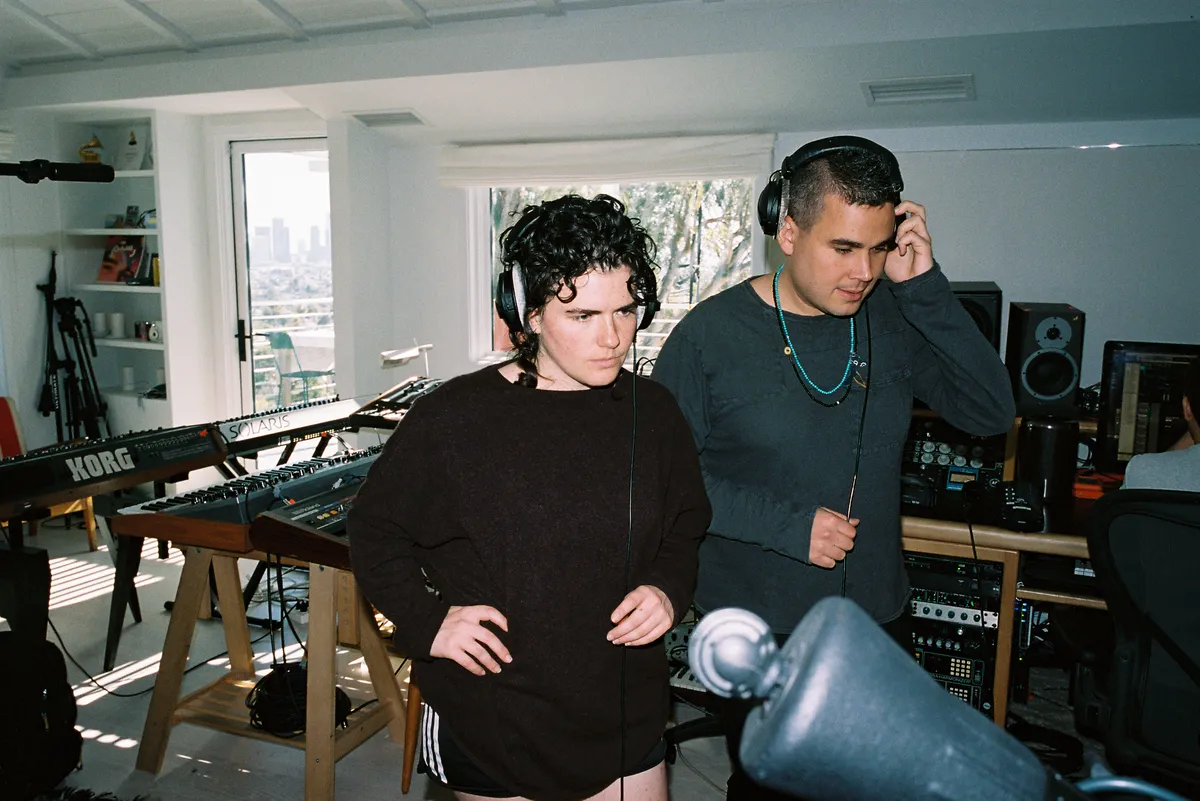
control. So they packed up their gear in a van
and drove all the way to Murcia in southeastern
Spain, where they rented a basement and set up
their studio. “Everything we’ve got can be transported—
you just rack it all up on these towers,”
De Martino explains. “Then more gear arrived in
a truck. We’d kept adding equipment ever since
the first band, and now, with Pro Tools, you can
write and record in even the most basic studio. In
good times or bad, we’ve always got five guitars,
two drum kits, a couple of old keyboard synths
and a load of outboard gear that we can valve off
and get some nice analog sounds. Obviously, the
success of the first album doubled the size of the
studio and gave us more facilities; that’s what we
ended up in Spain with.
“And then something clicked,” he continues.
“On my computer and my phone, I’ve got
playlists: I might have an xx track, MGMT,
Led Zep’s ‘Ramble On,’ a Madonna track, all
in one playlist. It’s what makes me feel good.
And because we were listening to music in that
way, we realized that we had to make an album
that sounds like a playlist. And that excited
us—all of a sudden it was like at the beginning
again: ‘We need to be in a band. We need to
write songs for a reason now.’ And that’s where
this record started. It’s not easy to do, because
you’re punkin’ out on ‘Give It Back’ and then
you’re doing an R&B kind of feel on ‘Day to
Day,’ or a sort of Nancy Sinatra feel on ‘One by
One,’ and you have to get yourself in that mood
each time you write and record. That was the
challenge. But we started working and the lyrics
started to flow. We were angry at our record
company, and if you read into ‘Hit Me Down
Sonny,’ it’s about Sony.
“They’re being brilliant now, both in the
States and the U.K. We’re starting small
again, we’re not worried about mainstream
radio, so we can go out on tour and be real.
But it’s been a long process to make the
record company understand that you can’t
treat us like Ke$ha.
“We just did some shows in Paris, and
they absolutely rocked,” De Martino says
with a mixture of pleasure and relief. “It was
Katie on the guitar and all the loops, me on
the drums, full energy, everybody screaming.
I was like, thank God. We came that close to
losing it.”
Bud Scoppa has written for Rolling Stone,
Creem, Rock, Fusion, Crawdaddy! and Phonograph
Record. He’s a senior editor at Hits and
industry-news site hitsdailydouble.com. His
current outlets include Uncut, Paste, and Mix.
More Online
Read
interview extras and outtakes.
Print Page