Print Page
Justin Meldal-Johnsen
8/21/2012
Bassist Justin Meldal-Johnsen’s résumé
reads like the ultimate session player’s dream.
His recording chops have graced the work of
Beck, Air, NIN, Emmylou Harris, The Mars
Volta, Macy Gray, Garbage, Goldfrapp, Black
Eyed Peas, Pink, Kid Rock, and dozens of
other artists. But unsatisfied with his gun-for-hire existence, Meldal-Johnsen recently
infiltrated the studio as a stealth producer.
He’s been part of major productions for
years, and his big ears have finally extended
to a place behind the glass. And he’s already
racking up successes. Meldal-Johnsen
produced M83’s 2011 electronic opus Hurry
Up, We’re Dreaming, and Neon Trees’ pop
rock chart topper, Picture Show. Meldal-Johnsen is currently producing energetic folk
sisters Tegan and Sara, as well as pop-punk
playthings Paramore.
Unlike the cash-and-carry, meat-and-potatoes
logic required of the session
musician, Meldal-Johnsen takes a decidedly
cerebral approach to his role as producer.
Whether that means creating mad wall
collages with M83 or getting all touchy-feely
and emotional with Neon Trees, Meldal-Johnsen seeks new ways to inspire musicians
to experiment, creating music that he, the
band, and the record label can be proud of,
and that will bring commercial success.
Most know you as a bassist, not as a producer.
My transition to producer has been under the
radar for years because until the M83 record,
I hadn’t done work that a large body of people
would recognize. After that [project], I got
calls from interested labels and managers.
I’ve produced three records that are less than
a year old now. Before that, I produced maybe
eight indie records, including Ken Andrews of
Failure, Division Day, Grace Woodroofe (with
Ben Harper), and Holly Palmer. I’ve always
exercised those muscles.
When did you begin exercising those muscles?
I’ve always tried to figure out songs and
texture and space and arrangements. I’ve spent
so much time on the other side of the glass that
I couldn’t help but be entranced by the process
of how to get a record going from start to finish.
I’ve always had this peripheral interest in how
to help an artist feel like they are being heard. I
don’t know if that is an ephemeral concept.
Being a producer is an ephemeral concept.
Does it take a certain kind of personality to
produce, and what elements are required?
I have always been a good listener and foil
for artists, from Beck to Trent Reznor to Air
to other people I’ve played with. In that role,
you gain trust. And within that trust, you’re
plugged into the nuances of someone’s creative
process. You hear and you see things that
others don’t see. You begin to understand their
aspirations. I’ve always tried to figure out how
to help people get the most distilled version of
themselves. That sounds high and mighty, but
that’s honestly where it’s at when I first meet
someone. “How can we get to the core of this
for them? What were the failings for them in
the past?”
How do you get to that core?
A lot of shooting the sh*t and gaining trust.
And in doing that, the more willing they
become to experiment. For a good producer,
it’s creating a utopian world where the artist
feels they can regain some of the freedom
that they may have lost in the past. When I do
that early on, I feel like I’ve got a fast track to
finding out the dos and the don’ts.
That sounds political.
It’s not about another producer, it’s finding
out where the artist’s records ended up versus
where he or she was trying to get. There’s
many variables in the process. If it involves
where someone was last with a producer, fine,
but making a record is a two-way street. You
can’t always fault a producer. There are all
kinds of cogs in the works that make an album
not go where it’s supposed to go. And there’s
lots of inter-relationship stuff that might not
have anything to do with the producer’s skill.
It may have everything to do with the A&R
guy harping on the producer or distractions
the artist had with management, ulterior
motives of band members, or drama. I try to
cut through all of that. I want artists to feel
like they’re getting something a bit more fully
realized. Artists are not going to be willing to
experiment in the studio unless they feel like
they’re acknowledged.
Don’t your credits command respect?
No. I have a lot of caché as a musician, but
as a producer, people feel they are giving me
a chance. For instance, I was able to make
Paramore feel comfortable by doing one song
first as a trial run. Producers with a lot of
experience don’t do that. But I still feel young
at this, like I have to prove myself. I have no
problem with being scrutinized. With a band
like Paramore who has sold millions of records,
that is fine.
What was your approach with M83?
With M83, it’s like, how close can you get to
the sun without being burned? They’re always
trying to push the boundaries of how bold,
how epic, how grand, how bright, or how
cinematic a song or an album can get without
becoming ludicrously overblown. One can only
go so far with layering and orchestrations and
spiraling ascending melodies until it becomes
trite. So with this album, it was all about how
to push things to the edge of that feeling of
jumping off the edge of the Grand Canyon
and flying.
How do you make that idea tangible?
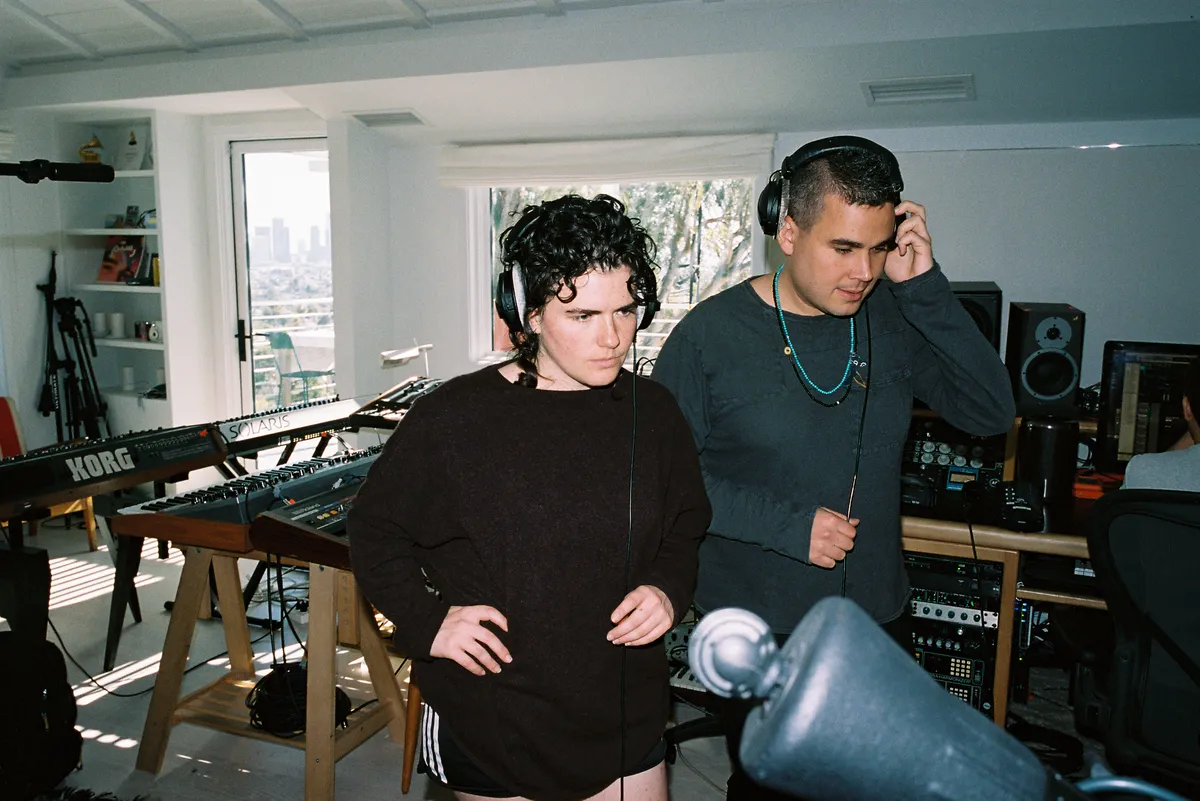
Anthony [Gonzalez] and I began with
discussions about regaining one’s youth and
that surprise of the world and the ambition
of being young. Then we sat in a room full of
synthesizers trying to out-inspire each other.
We created jams and put up rhythms and
played to them and co-created upon them.
You played a lot of instruments on Hurry
Up, We’re Dreaming.
We both did. As the creature started to
emerge, we felt that we had to do a lot of it
with our own hands; otherwise, it would be
compromised. I am not a guitar player, but I
play the lion’s share of guitar on the record.
There were a bunch of bad-ass musicians
that I brought in, but only for very specific
things. Otherwise Anthony and I went as far
as we could to play it all. The album became
very personal. It was a quest for us to figure
out a way to put in audio form the moments
when you feel most liberated as a child or
when you feel most inspired by the world or
the most touched by something ephemeral or
spiritual. It was like trying to merge reality
with the conceptual.
How did you put those thoughts into action?
We discussed old music, but after a while it
was nothing more than us keeping that ethos
in mind and continuing to create. One day we
got huge poster boards and made two dozen
of them and put them on this very high wall
in the studio. We wrote the manifesto of each
song and what it meant to us on the poster
boards. We’d cut things out of newspapers or
books and put those on the boards. Or tack
photographs or poems or bits of culture and
anything inspirational to the boards. Every
song would have this collage.
That had a literal impact on the music?
We did it at a juncture where we were slowing
down. As we added to the poster boards, they
became the bibliography for the rest of the
album. That kept us making music from a
non-mechanical and more instinctive place.
Sometimes Anthony would write out in the
desert. We had the luxury of time to do that.
We needed those moments, because without
them you don’t get a fresh look. We spent a
year making the M83 record.
You go the nth degree to get the artist to
exercise their imagination.
I was inspired by records like [U2’s] The
Unforgettable Fire, which was informed by
the actual location of the recording. I am also
inspired by records made at Compass Point, such
as Roxy Music’s Flesh and Blood and Avalon, all
the Grace Jones albums, Talking Heads’ Remain
In Light, so many albums. Those records had
great success getting people to disassociate from
daily life. Or 10cc’s “I’m Not In Love,” or London
Calling or Wire’s 154; they all had a ruthless
separation from expectation and pressure.
What was your process with Neon Trees?
It was different, because the stakes were higher.
They’ve always regarded themselves as a band
that has big ideas. They have a history that goes
well beyond what anyone has heard, and they
know a lot of cultural reference points that
help them articulate what they want. We had
a two-month window to indulge ourselves in
using the studio as an instrument. It is a pop
and alternative-rock album, but it’s certainly a
far cry from what the normal expectation of an
alternative pop band would have on their record.
You also engineered the album.
On everything I do, I am always engineering. I
use engineers to do two things: to help me get
drum sounds, and when at my studio, to help me
run the computer. I am very clear on what I want
from a sound or from an engineering approach.
What did Neon Trees want, and how did
you enable that?
Their last album was more of a collection
of single songs. It sounds very cohesive,
but it doesn’t have the drama and dips and
valleys that they were looking for. They saw
me as someone who could find a way to be
referential to their favorite records of the
’80s but to make it feel modern. I made sure
to consult every band member and get them
feeling like they owned it a bit more.
What was the approach for Paramore?
They had proven themselves time and time
again. They don’t need to be a pop-punk band
anymore. They can do their own ideas.
This sounds like something you might have
told them.
And also something they told me. They are
great writers and creators and they have savvy
reference points in the studio. The label needs
to have confidence that they aren’t necessarily
making Kid A, or even something more out on
a limb. I love pop songs and simplicity.
You mean Kid A as something out of left field?
In a sense, yes. All I’m really trying to say is
that we’re not trying to deliberately lose their
natural commerciality. I am here to articulate
their vision for a step of growth. I’m not afraid
to put a guitar through a modular synth, for
instance. I want the album to sound very
visceral and a little bit less locked down and
computerized—more 1981 than 2012, with a nod
to 2016. Humans playing textural sounds that
can still be heavy and fast, but also shaded.
How do you advise aspiring producers
to develop that knack of listening to the
artist? And being the middleman between
the artist and the label?
You can’t put frosting on it: You’re the
middleman. You don’t do this and expect to
be some juggernaut of selfish isolation. And
you can’t just assume that you’re walking into
circumstances that will go smoothly. You have
to always be on your toes. And the way you do
that the best is by listening instead of talking.
Listening to the artist or the label?
Both, by all means. It’s a very fluid situation, and
things are ever changing. You can’t rely on being
belligerent or bloody minded. You have to find
balance at every turn. You don’t have to cave to
everybody but you have to be confident in your
ideas. There’s a tripod there: your own confidence
with your vision, then the label’s vision, and then
the artist’s vision. And there’s a lot of foundational
stuff that young producers have to be on top of.
Like how to get great takes out of people without
relying on Beat Detective or cutting them up.
How to maintain a fresh sound. You do that
by keeping it old school and keeping alive the
romance of live recording and recording off the
cuff. On every record, I use rough or demo vocals
and guitars. Your job as a producer is to pluck
things out of the ether that have life.
And you find that on the scratch takes?
I always find good stuff on a scratch take. If it’s
not working, you have to stop and check the
last moment where it was working. That might
be before you told them you were doing vocal
takes for real. You have to make sure they are
on that front edge of enthusiasm. Then when
you get it, you stop. You have to learn that
right amount. I learned that by watching all
the producers who recorded me. You have to
understand people, and their thresholds and
interest levels and stamina levels. It’s important
to meet or apprentice with or read about people
who have made classic records. Because believe
me, they know something that you don’t.
Print Page