Print Page
Flying Lotus
9/28/2012
Moving Forward by Dialing Back on
Until the Quiet Comes
As flying Lotus, 28-year-old Steven Ellison
has released three increasingly acclaimed
full-length albums, several EPs and singles,
a generous amount of bumper music for
programming such as Cartoon Network’s
Adult Swim, and he has helped shepherd the
efforts of several like-minded circuit arsons
on his personal imprint Brainfeeder. Ellison
is preparing to release Until the Quiet Comes,
his fourth long player total and third LP for
U.K. label Warp, and with it he’s working to
break from some of his previously established
tendencies and insecurities.
Prior to composing Until the Quiet Comes,
Ellison moved from a house in L.A.’s Echo Park
to one in Mount Washington, CA, upgrading
his home studio’s acoustic space. He migrated
his primary workflow into Ableton Live. He’s
furthered his jazz-leaning piano-playing skills.
Most of all, however, Ellison has attempted
to unlearn. His self-declared approach on the
new album—which is a long-form concept
inspired by holographic universes, lucid
dreams, and astral projections—involves
recording a feeling of childlike innocence
through melodic refrains rather than the
urgent overdrive of 2010’s Cosmogramma.
Ellison’s formative palette isn’t exclusive.
He grew up like many kids in greater Los
Angeles: living inside a Nintendo; obsessing
over Dr. Dre and Snoop Doggy Dogg’s
Doggystyle; developing his relationship with
music while listening in the car as he traveled
around his hometown of Winnetka, CA,
deep in the west-central district of the San
Fernando Valley.
Eventually he was passed a mixtape that
revealed L.A.’s rave underground, a jungle
mix rinsed with hardcore breaks by DJ R.A.W.
This blend of percussive madness cut with
moments of melodic clarity was a gateway
drug that led him to the drill n’ bass and IDM
coming out of England. “I’d drive to Tower
Records at 10 p.m., when it was more empty . . .
and I’d take over a listening station, going to
the imports and trying to hear stuff I’d never
seen before,” says Ellison.
He went to college, studying film at the
Academy of Art University in San Francisco,
delving into the concepts of motif and
structure, of grain and edge enhancement,
of racking focus and cohesive narrative. In
college he expanded his experiences with
Aphex Twin, Squarepusher, Autechre,
J. Dilla, Madlib/Quasimoto, El-P, MF
Doom, Django Reinhardt, the Doors, and
Led Zeppelin, among many others that
encapsulated the same compelling flutter
and wow as a 35mm projector.
College also allowed Ellison new physical
interactions with music. Walking the city
streets, Ellison got to add new, grittier
context to pivotal albums. In addition, he
reassessed the texture of vinyl. “Hearing
Madlib, a guy who wasn’t afraid to flip
these jazzy records in new ways, was really
important, because at the time it was a lot
of Mannie Fresh productions, the No Limit
sound with keyboards,” says Ellison. “Madlib
opened me up to exploring old records
again, and I became convinced I could
sample and use keyboards.”
Perhaps the most fundamental realization
for Ellison was when a friend, who has worked
with the Brainfeeder label as a VJ under the
name Dr. Strangeloop, introduced him to the
potential of laptops. When not discussing
avant-garde film, the two would talk about
fringe music, and Ellison would sometimes
miss class because he’d be wrapped up in
creatively destroying media within his new
digital sketchbook.
 |
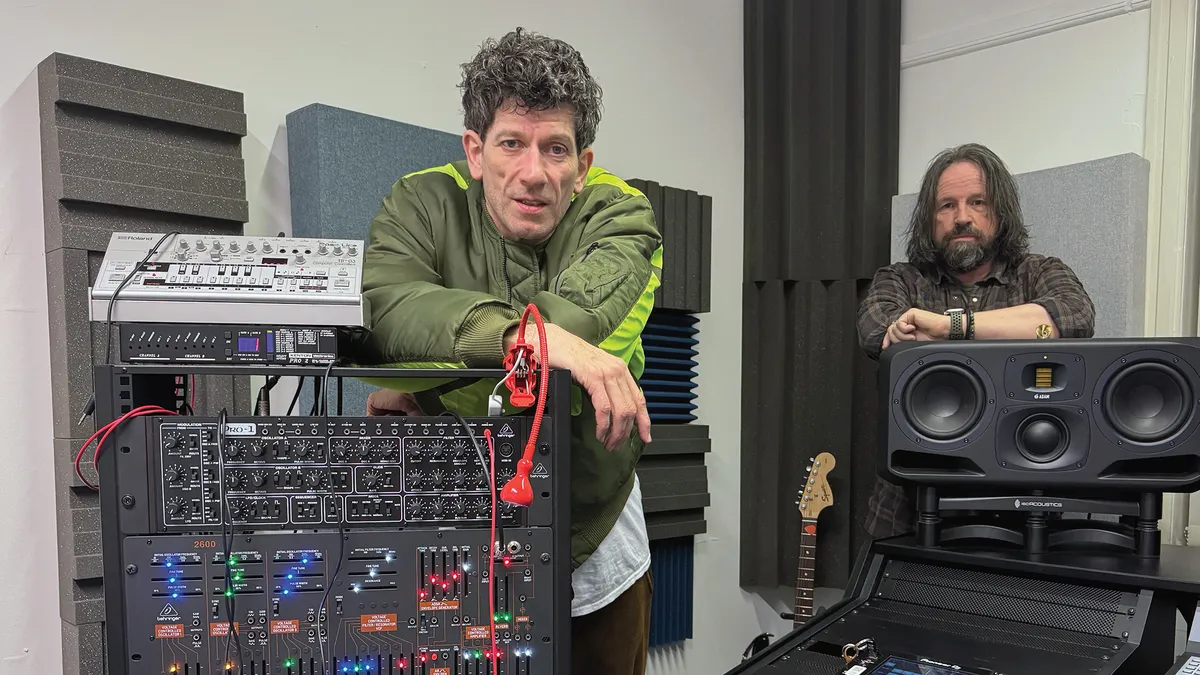
| Mastering engineer Daddy Kev |
Years and several releases would pass,
though Ellison never forgot his initial
fascination with G-funk’s repetitious drums,
whistling bass and meticulously sequenced
string machines and piano solos. Nor did he
neglect his Technics 1200s and stacks of wax,
slowly amassing a quite sizeable personally
sampled sample library. For a period, he did
concentrate on his film background, however,
assembling some materials for a documentary
on his great-aunt, meditative jazz pianist Alice
Coltrane (wife of pioneering saxophonist
John Coltrane). The documentary has yet to
materialize, but this bloodline is admittedly
beyond the public domain of influences, and
the family lineage partially explains certain
chord choices and the interest in astral
mystical states that permeates
Until the Quiet
Comes.
First and foremost, however, Ellison
retains the sense memory of when he was just
delving into his digital-analog hybrid sound
full of blown-out contrast and A-B moments
of striking transparency. “My biggest
influence is not wanting to repeat myself,
unifying the album around ideas that feel
brand new and . . . make an innocent feeling
come alive,” says Ellison. “When I tinker with
music, I try to remember that I’m always
going to be a student of it.”
Sitting in front of his Focal Professional
Twin6 Be monitors, flanked by a Moog
Voyager, Fender Rhodes, and Wurlitzer
electric pianos and an Access Virus TI synth,
among other key inputs, Ellison’s cockpit is a
collection of relatable tools. It’s here he drafts
the pressurized fragments and subtle artifacts
of his rustling dream world’s retro-futuristic
infrastructure, meticulously nudging clips off
the grid, flipping psychedelic soul synths over
layered irregularities. But to him it’s nothing
out of the ordinary.
“I think a lot of the theories about my
production are funny, because I don’t do
anything that is science fiction,” says Ellison.
“I use the same shit as everybody else, it’s just
that my ideas are a little different.
“Do I bit-crush? No, definitely not,” he
continues. “Do I drive things in the master?
Absolutely; it’s nothing unusual. For my
drums, I simply play them in myself and
don’t quantize it. I don’t see what’s so
mysterious about that; I’ve just got rhythm.
The only thing I use as a controller is an
Akai MPK49 and a mouse. I don’t even use
the pads on it that often to program drums; I
mostly key them in.”
You can still find a Reason instance up
on the MacBook Pro on occasion, as Ellison
finds the possibilities in Ableton Live
almost overwhelming at times. Recently
he appreciates some limitations within
his tools so he can focus more on mixing
and arrangements rather than pure tonal
pulverization. He even keeps collaboration
simple. For instance, Brainfeeder artist
Stephen “Thundercat” Bruner provides live
bass for several tracks, and the process was
as simple as plugging the bass into a DI on
Ellison’s Apogee Ensemble multichannel
FireWire interface.
“He riffs around, maybe I’ll suggest
where I feel it can be more or less busy,
and the combination of ideas manifests
itself into a bass line,” says Ellison. “All that
matters to me is getting the idea into the box
with the levels flat. Once it’s there, I have
more control on the actual tone and how
I want to maximize it, unify it with other
samples and virtual instruments.” Additional
elements include live strings, as well as
vocal contributions from Niki Randa, Laura
Darlington, Erykah Badu, and Radiohead’s
Thom Yorke.
Push play on Until the Quiet Comes and
round piano runs, plucky chords, panning
shakers, and a resounding thump coalesce.
Even when it sounds like jazz brushes are
turning into whips of static electricity and
the shaking of pens in a cup is in a heated
argument with some liquid funk, there’s less
of a feeling that the 8-bit themes of imaginary
video games are powering up to conspire
with a dissident breakbeat. Whereas on
previous albums there would be a tendency
to fold realities in on one another, the new
LP feels like it’s more composed around a
true north. “One of the reasons I named this
album what I did is because I feel there’s so
much chatter in my mind, around me, so I
worked so hard to find that quiet, confident
space to just be me.”
Another way you could look at the title is
in light of the album’s actual dynamic range,
which lends credence to the saying that
the master is now the student. “I’ve been
learning to bring things down before I even
start,” says Ellison. “I’ll start composing
a track at like –8dB, then I have all this
headroom to play with afterward. I’ve
learned how to tuck and limit things, learned
to EQ before you limit. I learned a lot of
things late, which is awesome because . . .
these opportunities to learn make me want
to work even more, to take advantage of this
new knowledge.
“I can get what I was getting, but with an
even better result now that it’s pulled down
more before the master,” he continues. “I
didn’t think in terms of, did I use this short
attack, this long release, and will it work again,
but through trial and error and multiple mixes,
I get it to where it sounds good. There’s more
restraint in this record and that was a lot of
fun to explore.”
A lot of this insight into more efficient
compression has come about through
interaction with Daddy Kev, Alpha Pup
Records label head and the mastering engineer
for the majority of FlyLo releases. Ellison
met Kev through the Low End Theory, a
“producer’s lounge” that Kev launched every
Wednesday at the Airliner in Lincoln Heights,
Los Angeles. The two met when Ellison
brought his laptop to freestyle at the beat
cypher, and they have been friends for much of
the past decade. One of the reasons Kev feels
the pairing works is because he understands
the mentality of producers who also do their
own mixdowns, and what type of input they
want in the process.
“I learned a long time ago, the best
engineers know how to shut the f**k up and
just work, and I pride myself on being able to
do that,” says Kev. “The mastering phase for
Flying Lotus isn’t just a technical process. It’s
him giving birth . . . and it’s very intimate. We
may go through multiple mixes so a certain
808 can sit right in the pocket for him, and
while he’s finishing his edits its my job to boost
just the right things by a decibel or two, and
keep things sonically correct.
To maintain and reinforce dynamics,
Kev uses a digital/analog signal chain on the
mastering rig at his Echo Chamber Studio in
Eagle Rock, Los Angeles, and he prefers to rely
on EQing rather than limiting to get desired
levels. First the Flying Lotus mixdowns go
into Pro Tools 9 on a Mac Pro working at
96/24 (to comply with Mastered for iTunes
stipulations). Here Kev applies Brainworx
bx_digital V2 EQ (“I always mono the
bass from 90Hz down,” he says) and uses
Sonalksis SV-517 mk2 Equaliser plug-ins for
the more detailed work.
“I like the Brainworx because of its fidelity
and it allows you to do very, very slight
adjustments to the EQ curve,” says Kev. “It also
does a frequency-isolation thing. Say you’re
sweeping up and down to see what you want
to adjust; it will only play back that frequency
+/-100Hz, to just give you that section when
you’re trying to find what you want to notch
out. The Sonalksis I think is very neutral, but
with a nice analog feel, and it has a setting
that displays a kind of spectral analysis of the
waveform as you play back, so you can see
what’s happening at a frequency.”
The signal then goes out an Apogee
Symphony I/O into a pair of Avedis e27
EQs, an Empirical Labs EL7 FATSO Jr.,
and an SSL FX-G384 gray-faced stereo bus
compressor. “The FATSO I only use for the
warmth effect it has, which is kind of like a
high-frequency limiter where it ducks out
the really nasty stuff,” says Kev. “I don’t use
it as a compressor at all. The SSL I hit for
the compression at 1dB max, more like a
half-decibel; gain reduction is barely moving
the needle.” The signal then goes back
into Pro Tools, where Kev uses the Sonnox
Oxford Limiter gingerly.
Monitoring with Focal Professional’s
CMS 65 and the CMS SUB, as well as a cluboriented
QSC KW153 and JBL SRX728S rig,
Daddy Kev helps solidify the familiar Flying
Lotus crunch, but with harmonic issues
toned down. Kev recognizes an influence on
that reduction is the result of Ellison’s new
philosophy toward excess.
“He used to be printing mixes that
were completely maxed, so this record was
definitely different, as he provided much more
headroom,” says Kev. “There’s usually quite
a bit of sidechaining, and he uses that kick to
trigger compression on a bunch of different
organ, string, bassline sounds, whatever he
wants to be affecting. I think since he’s moved
and upgraded his monitors, he’s become more
aware of the limitations of plug-ins, how far he
can really overload things without the signal
falling apart. Looking at way back until today,
his compositional understanding, his ability
to balance arrangements, has really moved
forward into a less-cluttered headspace.”
Indeed, Until the Quiet Comes is a Flying
Lotus album more redolent with salient
tones, and Ellison is proud to limit distracting
frequencies and unnecessary segues. “I’ve
been working diligently to explore theory,
but put clear feelings into the music, too,” he
says. “As long as technology has allowed us to
distribute music, I have been in the mix trying
to find stuff, and now I’m realizing the most
fun, effective ways I can share that feeling of
finding things that aren’t meant to happen
together, but work.”
Tony Ware, a writer-editor based outside
Washington, D.C., is more blooming onion
than Flying Lotus; multilayered, sometimes
a bit heavy, but always flavorful.
Print Page