Print Page
Aimee Mann
10/25/2012
When a brilliant songwriter and singer like Aimee Mann sets out to make
a pop record using The Cars as a sonic point of departure, cool things
are going to happen. The artist who was once best known as a pioneer in
the wide-open field of Internet music distribution has an Elvis Costelloesque
facility with words and a beautiful melodic sense. Meanwhile, she
and her producer/bassist Paul Bryan (Grant Lee Phillips, Nina Nastasia)
have a deep knowledge and critical distance, which help them use
sounds of their musical influences as springboards for brand-new ideas.
Mann’s latest, Charmer, does point to elements of The Cars’ massive,
hooky guitar and synth sounds, but there are loads of other evocative
moments, too, stemming from source material that spoke to Mann and
Bryan as they made the album. They found inspiration in everything
from New Wave to old detective shows.
Mann and Bryan are constant collaborators, so sounds and arrangements
are always being developed, even from the songwriting
stage. “He’s always around,” Mann says. “When we’re on tour, we play
together, and we’re really good friends. When I write a song, I always
send it to him and we start talking about it way before the [recording]
process starts.”
By the time Mann has a full album’s worth of material written, Bryan
will have a reasonably firm grasp of the sounds that they’ll be working
on in the studio, so he pulls together the musicians and instrumentation
they’ll need, and then he and Mann will rehearse with the band for a
couple of days before their studio session.
“Paul takes great players that play together in an interesting way, and
he knows how to ensure that there is a group thing that happens—that
magical thing that’s more than people playing
the songs,” Mann says. “He’s so good at directing
it and allowing it to happen. Some producers
are not sensitive to that. For instance, one
thing that will really kill it for me is doing too
many takes. It really helps to rehearse beforehand,
because if you get the band in the studio
and try to learn the song on the spot, all the
spontaneity is wasted on takes that have mistakes,
when people are just learning the chords.
The goal is to get fresh takes when people are
really inside the song.
Mann and Bryan have a kindred spirit in
engineer Ryan Freeland (Bonnie Raitt, Ray
LaMontagne, Joe Henry), who tracked most of
Charmer and mixed on his carefully designed
Pro Tools-meets-analog rig in his personal
studio, Stampede Origin (ryanfreeland.com). This is
Freeland’s sixth Aimee Mann album; he started
with her when he was Bob Clearmountain’s
assistant and she was making Bachelor No. 2
(2000). So if you trace Freeland’s path, Mann’s
albums are markers along his successful and
rewarding career. And he’s definitely with her
in terms of his general approach.
“I like making quick but informed choices
and keeping the creative momentum,” Freeland
says. “You keep everybody on track and focused
that way. The thing is that it can always be different.
Do you want something brighter? Something
darker? Something softer? Something
more distorted? Something cleaner? It could
be anything, you just need to make a choice. I
constantly think of this quote from [Willem] de
Kooning that says, ‘In art, one idea is as good as
another.’ In engineering, the decisions you make
are what define your style; someone else will
make a different choice. There isn’t a definitive
right or wrong, there’s just what you like and
how you hear it.’”
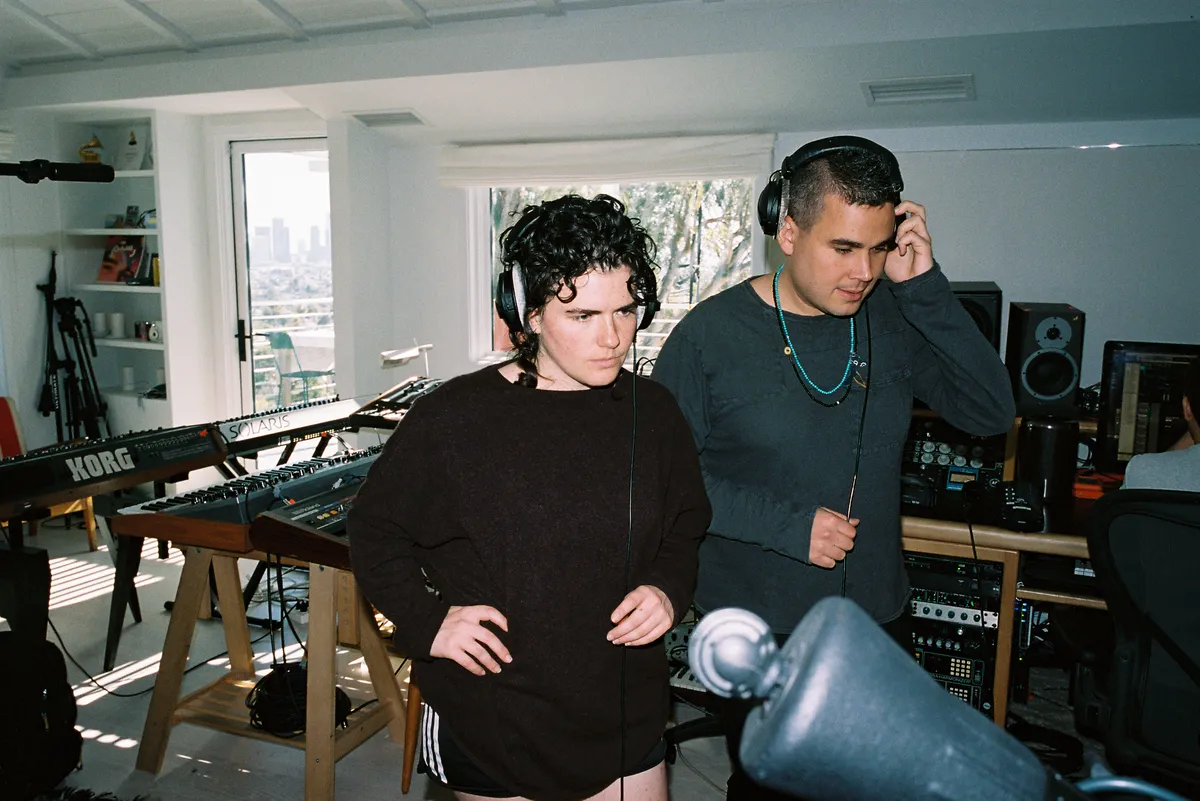
Not surprisingly, the musicians did a fair
amount of full-band, live tracking in Freeland’s
900-square-foot studio space. The largest
room at Stampede Origin is the control room,
so the keyboard rigs—two of them, for multi-instrumentalist
Jamie Edwards and keys/
piano player Jebin Bruni—were set up in the
room with Freeland. Drums and bass were
in the main (medium-sized) tracking room,
electric guitars were in one iso booth, and
Mann sang and played acoustic guitar in
another booth.
Freeland captures her vocal with effectively
the same chain he’s been using since 2000: a
Neumann M49 mic (in the past she’s also used a
U47) to a Brent Averill 1073 MPF (mic pre with
filter) to a Summit TLA-100 compressor.
“On a number of the takes, we got keeper
live vocals,” Freeland says, “Or they were close
enough to where I could edit between live
takes. What’s interesting with Aimee is her
guitar playing is fairly loud and her singing
is fairly soft, so if you put mics in the right
positions—even though she’s playing acoustic
and singing live—I can actually replace the live
vocal while keeping the live acoustic. This is
great, because the live acoustic is often driving
the track and difficult to replace without messing
up the vibe.
To showcase the vintage and offbeat instrument
sounds Mann was going for, “I used more
funky stuff on the keyboards,” Freeland
says. “I really like air on instruments—on
acoustic instruments or even with amps I
like to have a little bit of air or a little bit
of the room in them. So with keyboards I
always tend to use old tube mic pre’s, like
Ampex MX10s, which are just interesting
sounding. Or I’ve been using my pair of Retro
Instruments Powerstrips: They’re really amazing-
sounding boxes with a great DI. I wanted
to run the keys through something that sounds
a little weirder than what’s coming straight
out of the keyboard DI.”
Electric guitars were taken with a Royer
R-121 and an SM57. “I play with the blend or
the pan,” Freeland says. “If you want a wider
sound, you can move them wide; if you want
a really pin-pointy sound, move them close
together. I’ll use the brighter back side of the
121 if I want it to match the 57, or the front side
if I wanted a darker contrast. It happens really
quickly, but often within one take I’ll run in
there and move mics back a bit and spread
them wider. I have to make quick calls about
what it seems like will work in the mix. This is
the fun of being the recording engineer and
the mixing engineer; you can blur the line
and make what are usually mix decisions
while recording.”
Meanwhile, however, some of the insession
musical ideas weren’t sitting right
with Mann. “Jamie Edwards is just a master
sound crafter,” Mann says. “His sounds
are so inventive, and the parts he comes up
with are terrific. But there were a couple
of things that just weren’t working, and I
was having a hard time explaining. I had
a really specific thing in mind for certain
songs, but it can be like: “I’ll know it when
I hear it,” which is not helpful to anyone.
“Just keep trying some shit and we’ll see!”
That’s not an instruction. [Laughs.] So
when something didn’t seem right, Paul
and I holed up together at his studio and
went back to certain source music that
had been an inspiration for me when I was
writing the record.”
“‘Charmer’ was the big struggle,” Mann continues.
“The guitar was hooky, but it was almost too
hooky, and it was starting to drive me crazy. So we
went back and listened to The Cars and Split
Enz, which is a perfect example of that kind
of stiff, chunky rhythm guitar with a synthesizer
on top, and we listened to Blondie—pop
music of that era. It was very instructional.
Another thing we went back to, one of the big
points of reference, was actually the Rockford
Files theme. If you listen to the song, that sound
was right at the forefront. The Rockford Files
theme was a big influence on this record.”
Revisiting their source material helped
Mann and Bryan pinpoint and capture the
guitar, synth, and keys sounds they were after.
They re-recorded a few parts, and Freeland incorporated
the new parts into the mix in Stampede
Origin. “Most of the sound of my mixing
comes from my 2-bus chain and the way I
control it,” explains Freeland, who employs
an API summing mixer and a host of analog
outboard gear. “It’s the sound of my analog
EQs and a little bit of analog compression.
Also my reverbs are all analog: I have an EMT
140 plate and some old spring reverbs and a
Watkins/WEM Copicat echo. All the effects
for everything I’ve done for the past two years
have been outboard analog effects. In a way,
it’s part of defining a signature sound for my
studio. I’ve heard plate reverb plug-ins sound
really good on individual things, but as soon as
you start trying to put a little bit of everything
there, it doesn’t work the same. There’s an
interaction that happens when you’re hitting a
real plate with multiple instruments—and the
kind of smear of the picture it gives you—that I
find really compelling.
“I went for a very specific kind of sound
on Charmer that’s very different from Aimee’s
other albums,” Freeland continues. “The
sound I was going for was very specifically trying
to ride that pop line, but also being more
ragged and tough and not quite so beautiful,
because we wanted to rock out a little more.
Sonically, we went for a little less smooth, a
little more punk. To some extent, it came from
the drummer, J.J. Johnson, being so subtle in
the way he’ll shift the groove from verse to
chorus. And of course Aimee is always going
to sound like Aimee, but it’s fun that after all
these years we keep reinventing.”
Barbara Schultz is a frequent contributor to
Electronic Musician and Mix, as well as a book
editor and reviewer, among other things.
Print Page