Print Page
Master Class - Miking the Band, Part 2
2/21/2013
 |
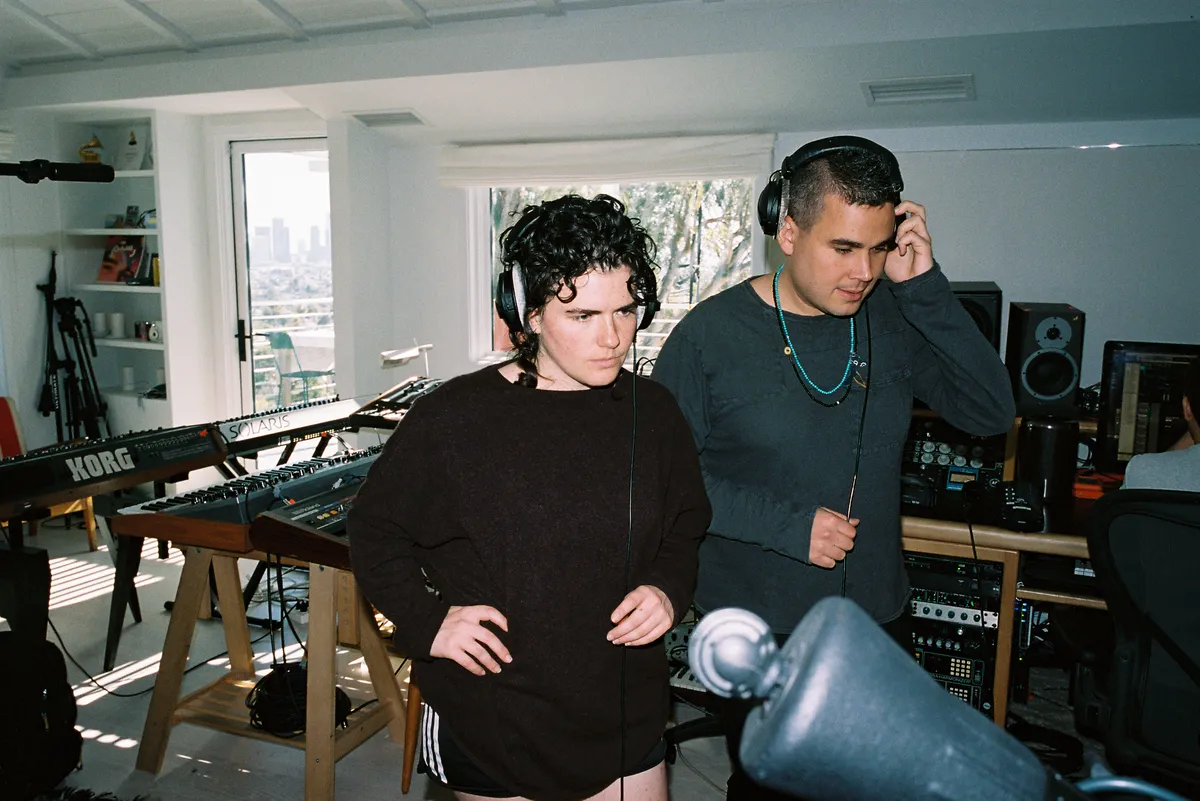
| Arizona band What Laura Says lays down tracks at The Farm. |
 |
| Fig. 1. This is one of the more traditional ways to mike a guitar amp. |
 |
| Fig. 2. Positioning the mic off-axis, and changing its angle, alters the amp’s tone. |
THE BEST-SOUNDING
mixes start with the best-sounding tracks.
In last month’s Master Class, I covered methods for miking
drums and bass. This time, let’s nail the vocals, guitars, and
electronic instruments.
Electric Guitar The classic approach is to place a dynamic
mic at near-contact distance from the grille cloth and let it rip,
but placement matters—you can vary the sound considerably
just by moving the mic a few inches.
An on-axis mic pointed directly at the center of the speaker’s
dust cap (Figure 1) provides a bright, articulate sound.
Moving the mic farther away from the center and progressively
closer to the speaker’s edge provides a darker, warmer, less-edgy
sound. I often place the mic out toward the speaker cone’s
edge, but angled in about 45 degrees, so it’s aimed at the dust
cap (Figure 2). This configuration usually provides a
good tonal balance—not too bright or too dark.
Other approaches include employing multiple mics, adding
a condenser mic or two a few feet back from the amp as “room”
or ambience mics, using a mic in conjunction with a direct box
(for later re-amping or providing a signal for amp-sim plugins),
or combining the miked sound with amp-sim hardware
such as the Tech 21 SansAmp products, Line 6 PODs, etc.
Assuming your audio interface has sufficient inputs, if you’re
short on mics or mic preamps but still want to track the band
all at once, consider trying some of these amp alternatives—
when tweaked properly, they can sound shockingly good.
Typical mic choices for guitar amps include moving-coil
dynamics such as the SM57, Audix i5, Sennheiser e609, and
Audio-Technica ATM650. Ribbon mics like the Royer R-101,
Cascade Fathead II, Beyer M160, MXL R144, and AEA R92 are also great choices for use on guitar amps
(and their figure-8 response opens up lots
of options when miking two cabs). While a
ribbon’s high-frequency response is somewhat
subdued compared to many condenser mics,
this characteristic can minimize any harsh
or abrasive qualities—yet its condenser-like,
quick transient response still provides a clear,
detailed sound.
Condenser mics can also work well on
guitar amps. Classic choices include the
Neumann U67 and AKG C-414 EB, but more
modern versions of the 414 can also work well,
as can other large-diaphragm condensers such
as the Neumann TLM102 and Mojave MA-300.
Earthworks’ SR Series multipurpose condenser
mics, while often used for acoustic guitars, also
work well with amps.
Indeed, many mics are suitable for electric
guitar amps, so the “best” model for the job can
easily change from song to song—or even from
overdub to overdub. Using mics with different
characteristic sounds on different tracks can help give them more distinct and individual
tones, so they stand out more easily in the mix.
Want to emphasize the attack or the treble in a
jangly guitar track? Try a brighter microphone,
such as a condenser. Want a smoother sound?
Try a ribbon.
Acoustic Guitar Tip number one: Start
with a great acoustic guitar. Put some new
strings on it a day or two in advance so
they’re fresh but have been on the guitar long
enough to have had a chance to stretch and
settle in so they’ll stay in tune. Finger-Ease
or a little talc can come in handy for reducing
finger squeaks.
 |
| Fig. 3. Compared to stereo miking, a single microphone can eliminate the possibility of phase cancellation. |
 |
| Fig. 4. When stereo miking, sum the signals in mono and make sure you have no phase-cancellation issues. If so, moving one mic slightly may solve the problem of phase cancellation. |
 |
| Fig. 5. X/Y miking is an option for obtaining a full-sounding stereo recording. |
Small-diaphragm condenser mics are
common choices for acoustic guitar, but
large-diaphragm condensers can also
work well. Even ribbon mics are suitable,
particularly when trying to tame an overly
bright guitar. Typical options include
the MXL 603, Audio-Technica AT4041
and Pro 37, Oktava MK012, Shure SM81,
Studio Projects B1, Royer R-101, and Beyer
M160. For classical guitar players with a
light touch, the Earthworks QTC Series is
designed specifically for quiet, low-level
sound sources.
One of the most common placements is
positioning the mic about six to 12 inches
directly in front of the 14th fret, angled in
slightly so it’s pointed toward the fingerboard
between the body’s edge and the sound hole
(Figure 3). For stereo, you can add a second
mic about the same distance away, but placed
over the lower bout (the lower curve of the
body) or just behind the bridge (Figure 4).
Another option is a classic X/Y stereo pair,
placed about 12 to 18 inches in front of the
guitar. I’ll normally center this stereo pair so
that it’s almost directly in front of the sound
hole (Figure 5). Pointing a mic at the hole
usually isn’t recommended because it can
sound way too muddy and boomy, but in the
X/Y pair’s 90-degree angle, the two mics will
be pointed to either “side” of the sound hole
instead of directly into it.
Vocals There’s usually nothing more important
than the lead vocal in your recording, because
it’s the element the average listener “connects”
with the most. The human voice conveys a lot of
emotion in addition to the main melody and the
lyrical message, so it’s crucial to get it right.
Start with the singers: Make sure they’re
healthy. To cut down on phlegm, I recommend
singers avoid dairy products for at least 24 to
48 hours before the session. Have lots of water
available, but not ice water; if it’s too cold, the
vocal folds can stiffen and contract. Stay away
from syrupy beverages such as sodas, and acidic
ones like orange juice. Comfort can be crucial
for vocalists—kick everyone else out of the room
if the singer finds others distracting, or if they
make the singer feel self-conscious.
Mic selection will depend mostly on
the singer’s style and the type of sound you
seek. Many modern recordings feature lead
vocals recorded with a large-diaphragm
condenser. Over the past several years, there’s
been a trend toward using mics with a fairly
bright-sounding top end to help a singer
“cut through” a busy mix. However, that
same brightness might not be appropriate
for a singer with a more treble-y or sibilant-sounding
voice. Common choices include the
classic heavyweight mics like the Neumann
M49, U47, and U67; the AKG C12; and the
Telefunken ELA M251. On a more real-world
budget, the AKG C-414, Mojave Audio MA-
200, Studio Projects C1, Avantone CV-12,
MXL V89, and RØDE NT1A are all respectable
choices.
Start with the mic placed six to 8 inches
away from the singer’s mouth, with a pop
screen half-way between the two (Figure
6). Moving closer can give a thicker, fuller
sound from the proximity effect, and can also
be useful for a super-close, intimate sound.
Moving back to around a foot from the mic
tends to minimize the proximity effect. Using a
baffle or other audio isolation tool (such as the sE Electronics Reflexion Filter or Primacoustic
VoxGuard) to the sides of, and behind, the mic
can help reduce room ambience pickup.
Moving-coil dynamic microphones
are often useful too; some very successful
records have been made with them. Classic
mics to consider are the Shure SM7b and
SM58, Sennheiser MD441, and Electro-Voice
RE20 and RE320. And don’t forget ribbons!
Before the dawn of condensers, the RCA 44
was frequently used, and other modern
ribbon mics can also work well for vocals—
especially if you’re after a smooth and sweet
“crooner” sound.
With background vocals, you can overdub
individual vocalists one track and part at a
time. This is a good approach if the singers
aren’t as prepared as they should be, or if you
think you might want to process (or correct)
the vocal tracks individually. An approach that
requires more advance rehearsal is to position
all the singers around a single omnidirectional
mic and have them sing their backing parts
simultaneously (Figure 7). Adjust the singers’
balance by moving individual singers closer
to, or farther away, from the mic until you
like the blend. You can then double-track or
“multitrack and stack” them for panned stereo
and to give the impression of a larger group of
singers, or for thicker-sounding parts.
 |
| Fig. 6. A good pop filter can help reduce plosives, thus reducing the need to edit them out when mixing. |
 |
| Fig. 7. Giving some distance to background vocals also gives depth, which can help during
mixdown to differentiate the background vocals from the lead vocal. |
While mics used for lead vocals can also
be effective on background vocals, consider
making two changes from the lead-vocal
miking approach. First, vary your mic if a
suitable substitute is available. This technique
will help differentiate the backing vocals from
the lead vocal parts, even if the same person
overdubbed all of the tracks. If the lead vocal sound is lower and darker, try using a brighter-sounding
mic when recording the background
vocals. Second, move away from the mic a bit.
Remember—distance equals depth. Physically
placing the background vocalists anywhere
from one to three feet farther away from the
mic than the lead singer gives a different, less
up-front sound that will help put them into a
different space when you go to mix.
Whenever you’re recording any vocals in
close proximity to the mic, use a good pop
filter or screen to help cut down on plosives
such as p-pops. These screens are also very
useful for establishing a “minimum working
distance” from the mic.
Synthesizers and Electronic
Instruments While synths and drum
machines don’t need miking, sometimes they
can have an unnatural sound when mixed with
acoustic or amplified instruments. Getting a mic
into the equation is often the solution.
With electronic instruments, space truly is
the final frontier. Although we listen through air,
hardware and virtual synths generate electrical
signals that need never reach air until we hear
the final mix. Compared to acoustic instruments,
synth sounds are relatively static—especially
since the rise of sample-playback machines. Yet
our ears are accustomed to hearing evolving,
complex acoustical waveforms that are unlike
synth waveforms, so creating a simple acoustic
environment for the synth is one way to end up
with a more interesting, complex sound. This
technique can also help synths blend in with
tracks that include miked instruments, because
they usually include some degree of room
ambience (even with fairly “dead” rooms).
Sending some (or even all) of your synth’s
signal to an amp and miking it can give that
feeling of “air.” For a clean sound, the Fender
Twin is an old standby; but an amp like Line
6’s DT25 or DT50 is an excellent choice, as it’s
possible to change the amp’s topology in the
analog domain to generate anything from clean
to dirty sounds.
 |
| Fig. 8. If you need more low end when using an amp with electronic instruments, try turning it into a pseudo-“closed-back” cabinet. |
Virtual instruments can take advantage of this
technique too—just pretend you’re re-amping a
guitar track. Send the virtual instrument output
directly to a hardware audio output on your
computer’s audio interface (this assumes that
your interface has multiple outputs), pad down
the output, run it into your amp, then feed the
mic into a spare audio interface input and record
this signal to your DAW. There will likely be
some delay introduced when going from digital
to analog then back to digital again, but you can
always compensate for this by “nudging” the
miked track a little bit earlier.
One issue with open-back guitar amps is that
they often lack low end. A quick fix is to place the
amp so its back lies against the floor (preferably
one with a rug), essentially turning it into a
closed-back cabinet (Figure 8). However, note
that with many amp designs, ventilation happens
through the cabinet back—so this technique
could block the airflow, which can be particularly
problematic with tubes. In this case monitor
temperatures carefully, and record for as short a
period of time as possible. Whenever you take a
break, move the cab back to its usual position to
let it vent for a while. Even if the amp appears to
be performing properly, heat buildup can reduce
component life. (See our Web extra for more
tips for getting a closed-back cab sound from an
open-back cab.)
Another way to add the feel of an acoustic
space to a synth is record the sound of the keys
being hit. (Sometimes a contact mic works best.)
Mix this very subtly in the background—just
enough to give a low-level aural “cue.” You may
be surprised at how much natural quality this
technique can add to synthesized keyboards.
General Tips Now that we’ve gone over
individual miking applications, let’s zoom out
and consider some tips that apply to a variety
of tracking situations.
• While close-miking techniques can
reduce the influence of room acoustics, the
location of your instruments and mics in a
room can affect your overall sound quality dramatically. Avoid boomy-sounding corners,
and don’t set up too close to walls that might
contribute unnatural reflections. If your
room is less than ideal, move the mics in close
and use as much baffling and broadband
absorption around your instruments and
mics as possible. You’ll have to “add in”
early reflections, ambience, and reverb at
mixdown, but this is often a better approach
than capturing negatively-colored room
reflections that you won’t be able to remove
from your tracks later.
• Don’t close-mike everything if you can avoid
it, because then everything may wind up
fighting for the up-front placement in the
mix. Give some advance thought to varying
the mic distances for various sound sources—
consider moving the mic positions farther
away from the source for supportive elements
than for main elements. This configuration
provides more “breathing room” in the mix,
and helps the parts sit in their own “space.”
• Remember that when using directional mics,
the proximity effect comes into play. Omni mics, however, can be placed ultra-close
without any significant bass boost. Also
remember that omni mics capture more of
the room’s character and ambience than
cardioid mics.
• Watch your recording levels—leave yourself
some headroom to avoid any digital “overs” or unexpected peaks that go “into the red.”
Ideally, track with levels averaging around
–8dBFS to –15dBFS on your DAW meters. If
your meters aren’t calibrated, I recommend
recording at levels that average about halfway
up the meters. Occasional peaks that go
higher are okay, but never light up that
clipping indicator!
• EQ and compression are fantastic tools,
but don’t reach for them first. Consider
changing an amp’s tone controls, adjusting
the mic position, or even using a different
mic. If the ribbon mics you’re using for the
drum overheads sound too dark, try some
condenser mics instead; if the guitar amp
sounds too bright, reposition the mic.
Phil O’Keefe is a multi-instrumentalist,
recording engineer/producer, and the
Associate Editor of Harmony Central. He has
engineered, produced, and performed on
countless recording sessions, with artists
such as Alien Ant Farm, Jules Day, and
Voodoo Glow Skulls. His articles have also
appeared in Keyboard and Guitar Player.
Print Page