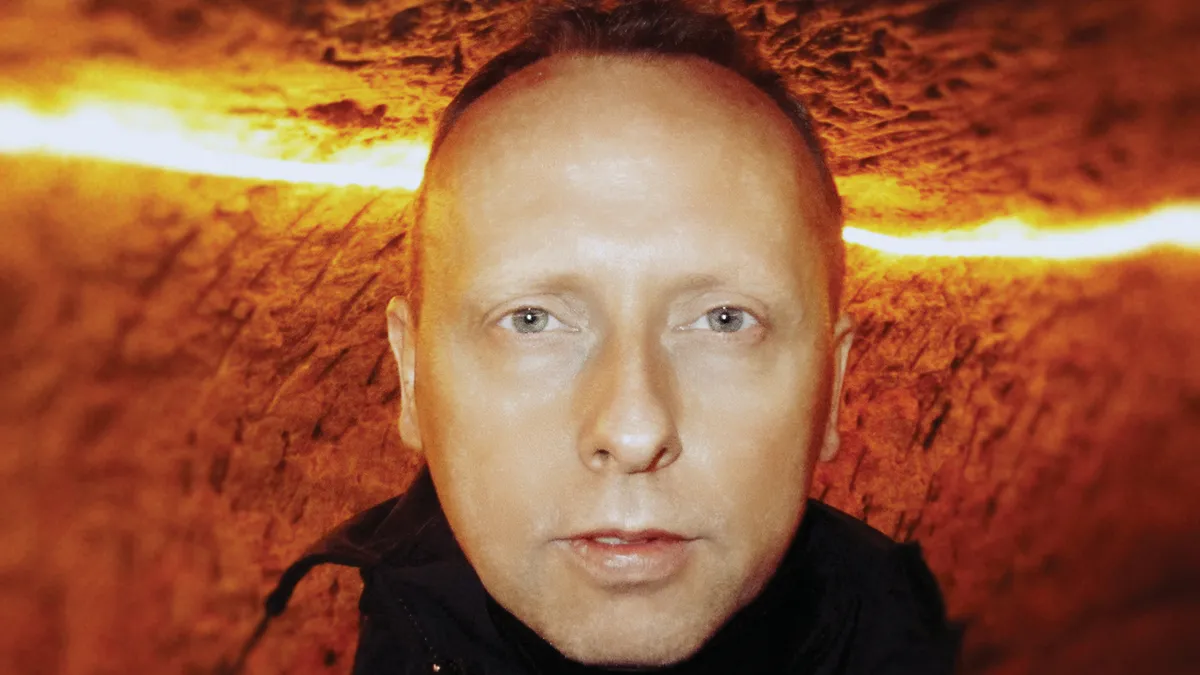
JOEL ZIMMERMAN spends the better part of his year
with a huge smile plastered across his face. Performing as his alter ego
Deadmau5, Zimmerman commands arenas with his meticulously produced waves of
progressive, electro, and tech house while wearing a bobbing, LED-encrusted 3D
helmet that grins maniacally at the EDM crowds. It’s a playful image,
but underneath that mau5head is a serious gear head, and not always a sunny
one. Whether on Tumblr, Twitter, YouTube, or in conversation, Zimmerman proves
himself to be bracingly honest, somewhat cagey, as willing to infuriate as
educate, but openly enthusiastic about the importance of experimentation and
working with an appreciation for efficiency and sonic transparency. Despite
being a guy who plays uplifting music for the masses, Zimmerman is not afraid
to stand behind an unpopular point, especially one that reinforces his refusal
to be just another follower. Over the past five years, Zimmerman has released a
steady stream of material, including 2012’s >album
title goes
here<, which compiles new productions with reworked singles.
The year
2012, however, might be most memorable among Deadmau5 followers for the
attention Zimmerman garnered from publishing a confession about/critique of
live electronic performance under the title “We All Push
Play.” What got lost in all the static about whether Ableton Live or
an arms-in-the-air headliner does all the work at concerts, however, was the
point that there wouldn’t even be something to play back if an
enormous effort wasn’t being put in to the studio, where Zimmerman
would say the best advice is don’t follow any advice too
closely.
Though prickly at times, the man behind the
mask is genuinely passionate about being gear
obsessed yet refuses to be a slave to any one means
of, or platform for, production. Championing a
tactile approach that places dynamic response
at the forefront, Zimmerman directs his scorn
proactively at those (this interviewer included)
whom he thinks just don’t get how to just get to it.
So you’re in Los Angeles right now;
how’s
that treating you?
It’s sunny and warm, not like Canada. Can’t
complain.
Looking back at your upbringing in the Niagara
Falls, Ontario, region, what part did
that play in your music?
Well, where I grew up, there were no electronic
musicians, really. There was no one else
leading the pack in that department, so it was a
really cool place to start out.
So, where did you find your first exposure
to electronic composition? I understand
you were in the Scream Tracker scene
[home to users of an integrated multitrack
step sequencer and sampler popular
among DOS users in the early 1990s].
Yeah, my exposure kind of began on the Internet,
joining various communities, hearing what all
these chiptune dudes in like Norway were doing,
and I got plugged into that for a little while,
making mod[ule] files. But I got a little more
localized when I hooked up with the dance
music radio station and worked in a record shop.
That’s where I got exposed to more produced
stuff as opposed to the hobbyist stuff.
 |
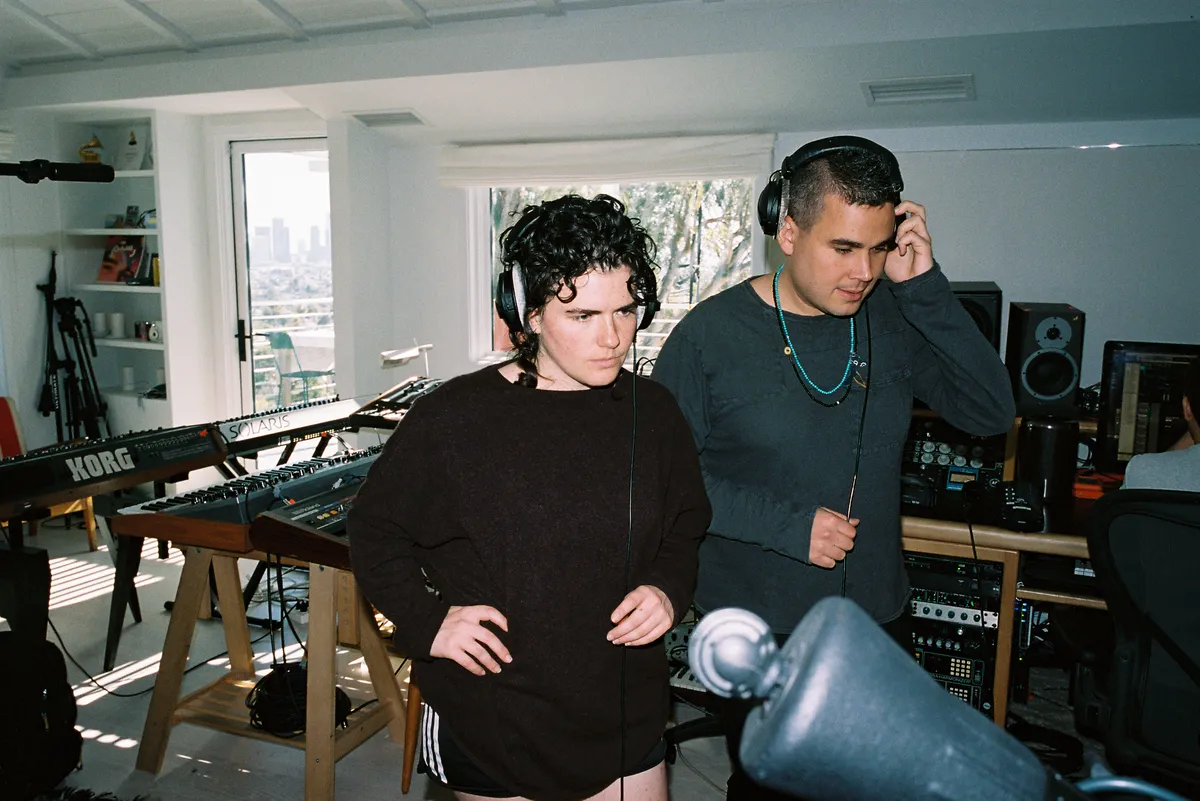
| Zimmerman’s studio in progress. |
What would you say were the first codified
genres that caught your interest?
Well, there weren’t really that many genres; it
was just straight-up house. The Porn Kings and
Armand Van Helden were killing it. There was
“Bombscare” and all that kind of stuff, but it
was all in the house vein, at least in my world.
There was no techno, no minimal, no f**king
progressive-neo-dubstep-tech.
Was there ever one defining recording that
caught your ear and inspired your direction?
Um, f**k, I don’t know, sh*t, [Ritchie Hawtin’s]
Decks, EFX & 909, I guess. Dude, I f**king
hate this sh*t, this interview f**king sucks.
I’m sorry, but “how do you feel,”
“what’s your
opinion”—this doesn’t help anyone; this
isn’t
informative. Who gives a f**k if I listen to
black metal or f**king country music?

Okay, let’s turn the conversation to building
a better mousetrap, then. What was the
first recording gear you picked up?
The first thing I bought was a Roland MC-303
[Groovebox] because Roland decided to make
some really cheap sh*t, which was good for kids
who don’t even have a job. That was fun, and I
really got into that; I remember being in high
school and I would just be reading that gear
manual during geography or whatever. That got
my head around oscillators, filters, your meatand-
potatoes-of-dance-music kind of stuff.
How did you first attempt to both use and
abuse that box?
You always found these little tricks, like how you
could run it into a computer and record .wav files
of just the samples of the thing and mess with
them, or you’d buy a cheapo distortion pedal
and record samples running it through that. I
was still very tracker oriented, so I would go and
make drum sounds and then affect them with the
DSP processors in the computer and throw those
into a tracking program. And then suddenly my
mod files sounded a little more up to date, as
opposed to using all these old crazy samples that
everyone was using. It was more interesting to
make my own thing for a change.
What was your first computer?
It was an Atari ST running C-Lab Notator, and I
had the dongle on it so I could send MIDI to the
303 or an old [Roland] Juno-60 that I had, and
that was interesting because it was getting me
out of tracker world and into MIDI. But I did end
up upgrading to an Intel 80486DX2 with some
SRAM in it, and I think I had a very early version
of Cubase in it. The old way of doing things was
to MIDI out all this stuff and then record what it
was, and that’s the end of it. But then VSTs came
out and I really tried to stay ahead on that curve.
That opened a lot more creative possibilities.
What’s your current
workstation?
I’ve been working with a company in Texas
called BOXX Technologies that’s been specially
tailoring PCs for me. They’ve built some of the
most reliable performance PCs I’ve seen. I used to build them myself,
but I’ve been supplied
with machines by BOXX for the past six years
now and they’re amazing. And it’s funny,
because I went into Hans Zimmer’s studio the
other day and he’s got racks of PCs from the
same company for his sample libraries. So I feel
even more like I did the right thing.
What’s your current ratio of hardware to
software in a production?
Probably about 70/20 on the hardware side,
a lot of that being my mastering stuff. My
compressors and limiters are all outboard, just
because I like the way the physical ones behave.
And I have all these modular synths; I’m loving
this gnarly-ass Modcan [a collection of rack
modules for complex, evolving monophonic
voices and external signal processing] I
commissioned [Modcan founder Bruce
Duncan] to do, and that was a f**king eightmonth
build. But it was all worth it; there are
lots of oscillators and options, just a big happyaccident
machine, really.
I’ve seen pictures; it’s an
impressive stack.
Cherry-pick some of your favorite components
Definitely the analog delays are great, and the
frequency shift is all analog, too. Frequency
shifts are a real horror to program, and even
then, to have it sound really great you have
to invoke some oversampling algorithms on
rendering and stuff like that. There are things
like that that you just can’t get a computer to
even get close to doing, at least in near real
time. And I’ve seen a lot of great filter VSTs
try, but when you can get an analog filter like
this, why try and replicate it? And even if the
filter does sound better as a VST versus an
analog one, it’s good to stay away from drawing
those automation envelopes, those perfectly
linear timed sweeps and things like that. When
you’re doing it by hand, you’re adding a kind of
subliminal nuance.
Do you compensate for or incorporate
subtle analog grit?
There’s always going to be noise, and when it
comes to modular synths, there’s no going back
to do another take of something just the way it
was before, so I’ll just patch in some ideas for
drums or big, nasty bass or whatever and work
with what’s recorded. It’s not the end of the world
if there’s dirt in a filter or you’re driving it just a
little too hard . . . distortion and clipping are two
different things, you know; computers are prone
to clipping, but analog just puts in distortion.
Tell me other ways you work with what
we’ll call “positive distortion.” Do you add
frequencies that will intentionally unsettle
or refocus the attention of a mix?
I think I’ve been producing my music a lot
differently than some of my peers. I tend to do the
mastering process almost about halfway through
the production of a track. I want to work on it as I
hear it, while other guys just work away on these
melodies and arrangements and all that, and after
they are all done they have to go back and mix and
master their tracks. With my workflow, I’ll know
whether to keep something at a reasonable level
or if the compression is just not right. I really like
to avoid printing audio whenever possible just in
case I want to go back and change something, or
come off a compressor a little less or something.
Do you approach compression more as subtle
adjustments rather than an overt effect?
A lot of people are busing everything to one
spot and then just sidechaining the hell out of
the thing, and then when the kick comes in,
everything disappears. But the problem you’re
going to run into is, when you mute the kick, the
whole dynamic of the song is going to change.
A lot of people tend to overdo that, and what
they do instead is they mute the kick but still
send the kick signal into the rest of the stuff. So
you’re not hearing the kick, but you are hearing
the sidechain result and it’s god-f**king awful,
but it’s the only way you’re going to escape not
changing the dynamic of the track throughout.
In terms of compression, I so rarely go over 1:4
just for that reason. I want it to sound just as
good with no sidechain.
A lot of people do what they do for volume
reasons, but the thing is, dude, if you really want
your track to be loud, turn the f**king volume
up, don’t limit the sh*t out of everything. As soon
as you start taking away that one element that’s
sidechaining it or limiting it, your track is going to
blow out all to hell and you’ll be wondering, why
is it so much louder than this other part when I
wasn’t limiting it? So it’s good to A/B when
you’re
sidechaining or doing any of those other f**king
A-to-Z house music moves where you can just
totally ruin a track. I tend to keep it very subtle
and then gradually ramp it to a point where I can
hear the difference as to whether all of these buses
combine or not, and then I’ll just start knocking
back levels as opposed to sidechain amounts or
ratios on each of the buses. At the end of the day,
they are all running into my master chain, which
is going to be probably a Neve EQ and a Weiss DS1
[compressor/limiter/de-esser] as the last thing
anything sees for maximization.
Do you lean toward that choice to apply
coloration or control?
The thing with the Weiss is, it is so f**king
transparent that you’re getting the loudness
but you are keeping the dynamics. Another
thing, too, is poor Waves designed this L1
[Ultramaximizer] for a reason, and a lot of
people are just taking the threshold of that
and bringing it half down to -30dB and just
sausaging out their tracks. So, great, sounds
really loud good for you, buddy, but here’s the
problem: When that gets played in a nightclub,
the amps are going to limit that again. And if
you play something with more dynamic range,
the amps are going to have more headroom to
go up louder, so I’m very happy it sounds great
on your f**king monitors, but it’s going to sound
like ass in a club.
It’s one thing to lift up a tuned noise floor
in
between compressor hits and make a deliberate
rhythmic effect, but you feel that a lot
of producers don’t see a difference between
super tight and plain constricted mixing?
I’m not a f**king crusader . . . if you think
something sounds great, then great, use that.
But it’s just such a shame because you have to
realize that when you’re producing electronic
music that’s going to be played in environments
that have copious amounts of amplification,
you have to think outside the monitors in your
house, you have to think about the nightclub
system or the arena system. Imagine setting
your L1, and then what you should do is copy
that L1 and paste that again after it and see how
terrible it sounds, because that’s what the amps
are going to do to it. Maybe I’m the only guy
who is sitting out in the crowd thinking, ‘Man,
this is just so limited,’ but it’s just a constant
noise, a car horn in your f**king ear where you
want to hear music. Yeah, when it was loud for
that one second, it had that punch, but when it
lulled out, the volume still stayed . . . Thinking
about this is something that is just blatantly
thrown out the window in electronic music just
because of some guy’s f**king dumbsh*t pro tip
in Keyboard magazine or wherever the f**k
Well, we did collect reader questions, and a lot
of them did request some pro tips from you,
like finding out what your technique for tightening
a particular kick might be, or whether
you tune your kicks to the song’s key, etc.
Oh f**k, yeah . . . I don’t do it all the time, but you
should always make note of the fundamental
frequency in a kick drum . . . and that can be
found by using any free spectral imaging plugin
or EQ that’s going to show the peaks and all
that stuff. It’s not hard to find, it’s the swell in
the middle of the EQ that’s peaking the highest.
So what I do like to do with kicks is just use a
sine wave and tune that sine wave . . . go up a few
octaves if your monitors suck, and then bring it
back down because you don’t have to necessarily
hear it when you can see it. And then obviously
you’re going to do a little bit of envelope shaping
on that sine wave, but that’s not the kick, that’s
basically an 808 with no attack on it, no punch.
For that punch, you can go through all these
millions of sample libraries and start to find the
top and mid of that kick, to add the transient,
the punch of it. The way that I do it is, I split
three tracks for a kick sound, sometimes even
four or five, and I’ll start layering the sounds
but splitting them up in frequencies so you have
your fundamental sine wave, a mid one, which
might be some old ’60s cut that might be only
1,000 samples long—a little, tiny thing—and then
a couple more that are in and out of time. And as
you move those and mess with the phase a bit,
you can get it a little more slappy or not slappy,
and then you’ve got that kick. So render that out.
It sounds like the rhythmic elements are what
take you the most time to consolidate. Why
produce and grid out all these one shots?
A lot of times, the more parts you can have, the
better, because you can re-introduce or swing
different parts without f**king up entire loops.
It’s got a lot to do with the placement and timing
of that kick. Even though it’s dance music and
it’s not f**king rocket science to place one on
every quarter note, it doesn’t hurt to nudge it
backward a millisecond because that’s going to
trigger a key sooner and give a little bit of time
for the plug-in to process after the transient
or during the transient. Because if you do
everything from zero onward, you’re going to run
into latency problems. And I’m talking changes
in the microsecond range, not so much making
a loop that’s way off. You’d be surprised what
you can do by making micro adjustments to the
placement of a kick, especially when it’s being
used as a key for a compressor. If you bring it
back just a little bit early, then you can hear a
transient much better before the compressor just
destroys it, squashes it down by 1:8 or 1:10.
So far, a lot of our conversation has centered
on percussion; is that where you start
a lot of your production?
Yeah, because I can usually tell where the
track is going to go from there. Agreeing on a
fundamental frequency for a bass drum is going
to pretty much determine where the root is going
to go, up a fifth, seventh, an octave, whatever. I
tend to do that unless I’ve done this kind of kick
that has so much going on for the fundamental
frequency that you can go any way with it. I think
of it as an elaborate click track, basically, in that
I am going from there and start drawing in notes
and melodies, pads and all this stuff, coming up
with phrases . . . making 8, 16, 32 bars to keep on
with that club-music formula.
Over time, have you found that your tools
have fit the music or your music has fit the
tools? Has any piece of gear or production
technique resulted in a large body of work?
It’s all experimentation. I just go out and get the
thing I don’t have and play around with it and
see if I can shape some kind of sound out of it.
Melody is never a problem; as long as I have a
sound font of a piano, I could write melodies the
rest of my life. Beethoven didn’t have too hard
of a f**king time, you know what I mean?
I saw on your Twitter feed that you just
upgraded your monitors to the PMC IB2S.
Those are actually really great, f**king amazing
for the price. I’m in a weird room right now, and
I’m doing some modifications to it and putting
paneling up, though with this room I’m been
pretty damn lucky because the bass goes right
through it and doesn’t bounce back and cause
bullsh*t pockets. But I’m still having a little bit of
trouble with the mids and the highs because of
a rounded ceiling above me. The PMC speakers
are really tight, and I can hear like 40Hz at really
low volume, which is really important because I
don’t like really piercing-loud sh*t. I like clarity
and transparency and comfortable listening levels;
I don’t want to walk away from the studio at
my ears ringing. But it’s true what they say: The
speakers are only as good as the room they are
in. The room is 70 percent of the sound when it
comes to engineering, so I’m retrofitting this guest
room in this house to disperse some reflections.
Is there a magic piece of gear or plug-in
in this new studio that can glue a track
together more effectively?
Oh yeah, maketrack.exe is that app—you know,
the one where you just push the button and
all the music comes out . . . I bet you we’re not
far off from that, but thankfully, the spirit of
producing prevails and most programmers are
less interested in doing something like that
than making more powerful task-specific tools
to achieve one thing rather than all of it at
once. The DJ dance studio fad came and went
when the world realized that people actually
want to work at making their music.
I’m going to throw out a hypothetical
situation:
Your studio is on fire, you’ve collected
the cats, is there a single piece of gear you’d
grab to start your studio over?
It’s got to be the box, it all starts with the BOXX
now, but if I lose it, I lose it. If you fear that losing
the equipment would cost you your creativity,
you weren’t that talented to begin with and you
should start considering a second career. So, if you
feel that you’ll never write anything amazing ever
again, you’d better have a lot of backup drives.
Looking back, your past year has been a
busy one for productions, touring, and
sparking discussions throughout dance
music forums. Is there anything you would
do differently, going forward?
I’m less concerned with the ongoing question
of what’s going to happen and how to change
to benefit from that somehow. As long as you
remain creative and keep moving forward
with your own ideas, doing different things
your own way as opposed to designing in a
way that you know is going to be popular with
everyone else, then you will always be not
another sheep, you’ll always be looked at as a
starter rather than a guy who jumps on a thing.
And that’s really important to me, to challenge
myself before sounding like everyone else.
Is there a particular direction you see yourself
heading as a challenge in the near future?
Yeah, I’m heading toward Norwegian black metal
run through a Sherman Filterbank and calling
it a remix. But really, I am building a 52-foot
mobile production studio that I’m taking on tour
that will be more or less a replica of my room in
Toronto, just inside a massive truck so we can
do all kinds of cool sh*t with it. We’re going to
do live broadcasts from the road, inviting fans
and friends and people in our little electronic
world to come in and collaborate and do a thing
in there called mau5hax [a Livestream session
featuring Deadmau5 and others working with
start-up producers and discussing production
topics]. The new live show we’re working on is
so involved, we’re looking at two-day stage build
times, so we might as well just park a studio out
there where I can work instead of just sitting
around picking my nose in a f**king hotel room
wishing I was at home making music.
And what’s at the core of that
workstation?
Ableton is working out, but I’m looking at Cubase
these days just for better mix control in terms of
the way their busing system works, their EQs,
and the way their layout is a little more engineerfriendly.
As an arrangement tool, Ableton f**king
rocks, but as an engineering tool it sucks and
Cubase rocks. But you can combine the two with
a ReWire client, and I’ve found that to be very
useful. I don’t want to give away too much, but on
stage there’s a lot of f**king sh*t going on up there,
in terms of both Mac and PC. The MIDI in Cubase
has always been bang on, where you do global
adjustments on timing, like moving a latency slider
over a bit, whereas in Ableton, you start f**king
with that plug-in delay compensation sh*t, you’re
entering into a world of f**king disappointment.
Cubase has been a lot more reliable when it comes
to timing-specific things.
If you could invent the perfect DAW, you’d
be doing a lot of people and some companies
a favor.
I don’t think it will ever come to a solution
that’s
perfect for everyone; everyone will always have
some obscure, weighted thing. I’ve never seen
a “live electronic music” setup that didn’t have
some weird f**king workaround or some weird
ingenious way of combining different things. It’s
always been that way and it always be that way,
or we’ll all just end up using [High End Systems’]
Road Hog [consoles] and Ableton, and show
technology won’t advance. Any developer that
sees someone is using this-and-this for a task can
come up with something new to deal with those
chores specifically, but of course you’re going to
have a new problem, and then a new solution,
and then another problem.
Tony Ware is a Northern Virginia-based writer, editor, and
friend to felines. When he’s not busy playing a game of cat and mouse
with producers, he enjoys chasing down high-resolution audio, delicious coffee,
and iOS synths.