By | Sat, 01 Jan 2011
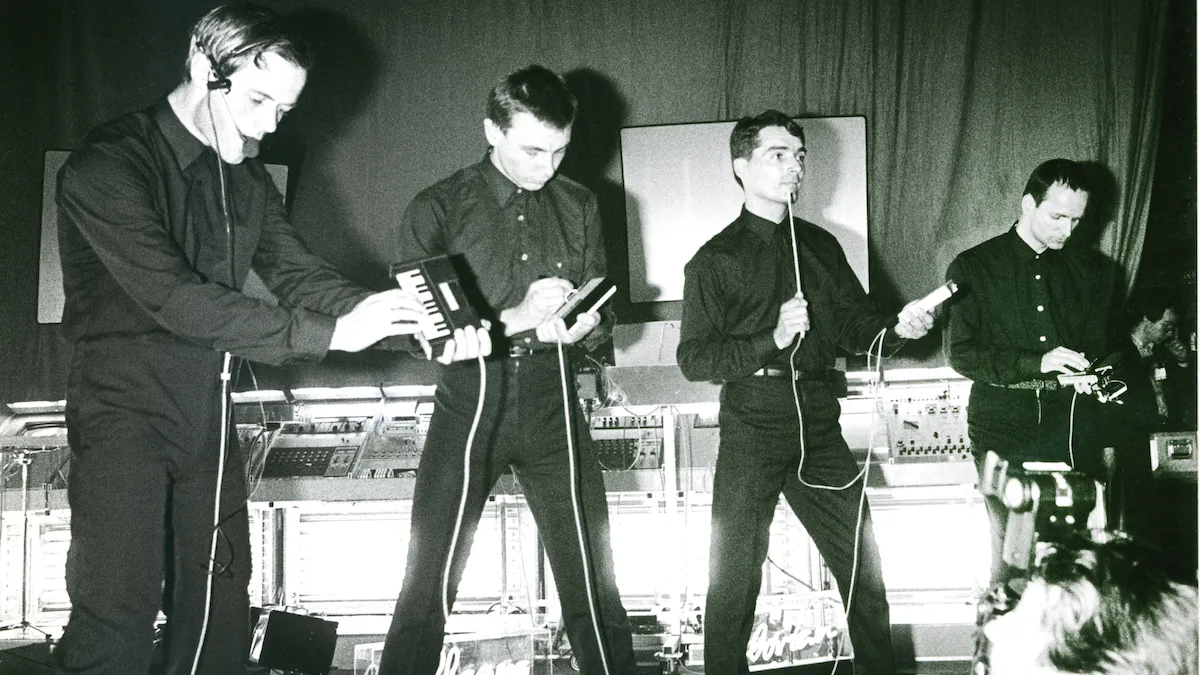
Gang of Four (left to right)—Thomas McNeice, Jon King, Mark Heaney, and Andy Gill.
Post-punk legends Gang of Four revisit
old principles and crank up the transistor
amps on Content
By Patrick Sisson
Last October, Gang of Four guitarist and producer Andy Gill delivered a
lecture on recording to students at the Liverpool Institute for Performing
Arts. The influential post-punk guitarist wasn’t afraid to be self-effacing: He
played one of his band’s lesser-known songs, an early ’90s cover of Bob
Marley’s “Soul Rebel,” and asked students to tell him what was wrong. He
waited until one said it sounded like “catwalk music” before he agreed.
“[Complex production]
can sound amazing,
and the programming
can be fantastic,” says
Gill,” but to me, it’s
falling in love with the
samples and MIDI programming
and forgetting
what you’re about.
It’s not Gang of Four
music. It could be great for something else.”
Content, which Gill recorded over the past two
years at his own Beauchamp Studio in Central London,
is a return to form—aggressive, prickly, and
muscular. Gill worked over song ideas with founding
member and vocalist Jon King, perfecting tight,
rhythmic arrangements before bringing on newer
members Thomas McNeice (bass) and Mark
Heaney (drums) for recording.
“One of the beauties of guitar/bass/drums is you
have a lot of space,” says Gill. “More traditional pop
music has this hierarchical, pyramid structure, with lead
vocals on top, guitar below it, and then keyboards and
backing vocals, all meant to support the lead vocals.
One of the things Gang of Four did was put everything
side by side. It all worked together and created a
rhythmic network, which fed into our aesthetic ideas.”
A signature aspect of Gang of Four’s style is
Gill’s “shards of sound” guitar technique. Influenced
by Hendrix, the jerky playing of Dr. Feelgood’s Wilko
Johnson, Steve Cropper of Stax Records fame, and
blues icons like Howlin’ Wolf, Gill played through
transistor amps, as he did on 1979’s Entertainment
and 1981’s Solid Gold (in this case, either a Peavey
Classic 50 Combo or Blackstar Artisan 30).
“Everybody looked down their nose at me, because
proper musicians are supposed to use valves,” says
Gill. “That’s always been the case. I liked the coldness,
if you like, of transistor amps. With the Fender
Strat and the PV combo, you can get a thinness of
sound. You don’t end up with the big, fat Marshall
distorted sound. It’s thin, bright, and sharp.”
Gill routes his Fender Strat with Lace Sensor pickups
(which result in less buzz when gain is added)
through a DI, sending one signal straight to Logic and
the other through the amp, blending the amp mic
tracks with a track modified with plug-ins, including
the Logic amp simulator or Pedalboard. On the Peavey, for example, he normally places
Latvian-made JZ mics such as the
uniquely-shaped Black Hole or the BT201
as a pair in front of the amp, and then
maybe a Neumann U67 in the back for
room sound. “I find that quite exciting,
switching between them,” he says. “If you
record those mics in the mix, you can cut
one out and bring another in and automate
the levels. It’s a bit like the dub techniques;
it helps drive the narrative of the song.”
Gill’s dry, rhythmic, and cutting
sound—he describes a certain frantic
section of his playing on “Do As I Say”
as him “setting fire” to singer King—
doesn’t rely on compression or many
pedals, though he will use the Boss SL-
20 Slicer. His only “vice,” as he
describes it, is tremolo, especially the
effect on the Boss pedal. He can lock to the
track via MIDI and program different rhythms
within the tremolo, which you can hear on
the vibrating, flinty intro of “She Said.”
“When I’m recording drums, I use compressors,
because I know what I want and
I want to get as close to that sound as I
can when I’m going in,” says Gill. “I don’t
want a natural sound. I’m not a jazz guy
who sets a few mics around the room. I
want my drums to sound big. I always listen
to the drums as much as anything
else. I get off on great-sounding drums.”
On Content, Gill surrounded Heaney’s
PDP kit with various mics, including a pair of
Curtis valve mics hung three feet above the
kit for overhead coverage; he found them
crucial for the right tom sound. The kick
drums and snare were close-miked from
various angles and sent through a variety of
compressors (UREI 1176, dbx 160, and a
PYE model from the ’60s), and Gill would
ride up the room sound for extra emphasis.
The kick had a D112 inside and either a
Neumann 47 or 67 outside, usually placed
about one-and-a-half or two feet away. “For
the snare, I use an SM57 or Beyerdynamic
M88, an SM85, and a KSM44,” says Gill.
“The 44 I usually put close and send through
a Transient Designer for more whack and
crack; it gives it character. Any mic under the
snare will do, just to add to the rattle."
The album was rounded out with
King’s vocals, captured on a Shure 57 or
Neumann 67 and given a touch of delay
and reverb with the PCM 70 or 80 and
Logic reverb, “to help the vocals sit in the
track.” Sometimes Gill would set up a bus
within Logic to send vocal tracks through
a load of distortion or send it through a
high-pass filter to take out everything
over 300Hz. With trademark politicallycharged
lyrics, the relatively unadorned
vocals don’t muddle the message.
It’s clear that the work of these Leeds
University classmates still resonates. And
while Gill’s work as a producer of the last
few decades has included sessions with
bands ranging from the Red Hot Chili
Peppers to the late INXS singer Michael
Hutchence, it’s exciting to hear him back
with his original band.