The dark-hearted Jersey boys of The Black Parade return
with a “poisonous” punk-disco-power pop hangover on
Danger Days: The True Lives of the Fabulous Killjoys
“We wanted modern rock to move forward,”
producer Rob Cavallo says, regarding
his latest My Chemical Romance
production. “We wanted the record to not
sound like anything else that was on the
landscape of modern rock radio. It’s the
next leap. The next invention of My Chemical
Romance.” “I wanted it to be a poisonous
album,” My Chemical Romance
mastermind Gerard Way adds. “I wanted
it to contaminate things. I want the album
to have this ‘neurotoxin’ quality.”
A supercharged progression from The
Black Parade, My Chemical Romance’s
Danger Days: The True Lives of the Fabulous
Killjoys is what happens when a
band directs their fate. Initially recording
with Brendan O’Brien, the album was
considered completed and then played
for the press. In late ’09, however, MCR
suddenly dumped the record and started
from scratch. Enlisting The Black Parade producer
and Warner Bros. chairman Rob Cavallo,
MCR tumbled into his Lightning Sound
studios with nothing, and emerged with an
entirely new Danger Days, a graphic audio
novel of multiple styles wrapped in Cavallo’s
glistening studio sheen. Gerard Way details
the journey:
“Working with Brendan was like, ‘Let’s be
in preproduction a lot, let’s write a bunch of
songs, let’s record live.’ But the spark wasn’t
there. The record felt naked and empty, and
there was no fixing it. Once we got to Rob
Cavallo’s place [in January, 2010], we built the
music in the control room together. We’d start
with a drum loop, then add a guitar, and if I
had a lyric, I’d sing it in the other room; we’d
build and build. Most of the tracks were completely
constructed in a control room, as
opposed to a band playing instruments
together. It was like improv rock.”
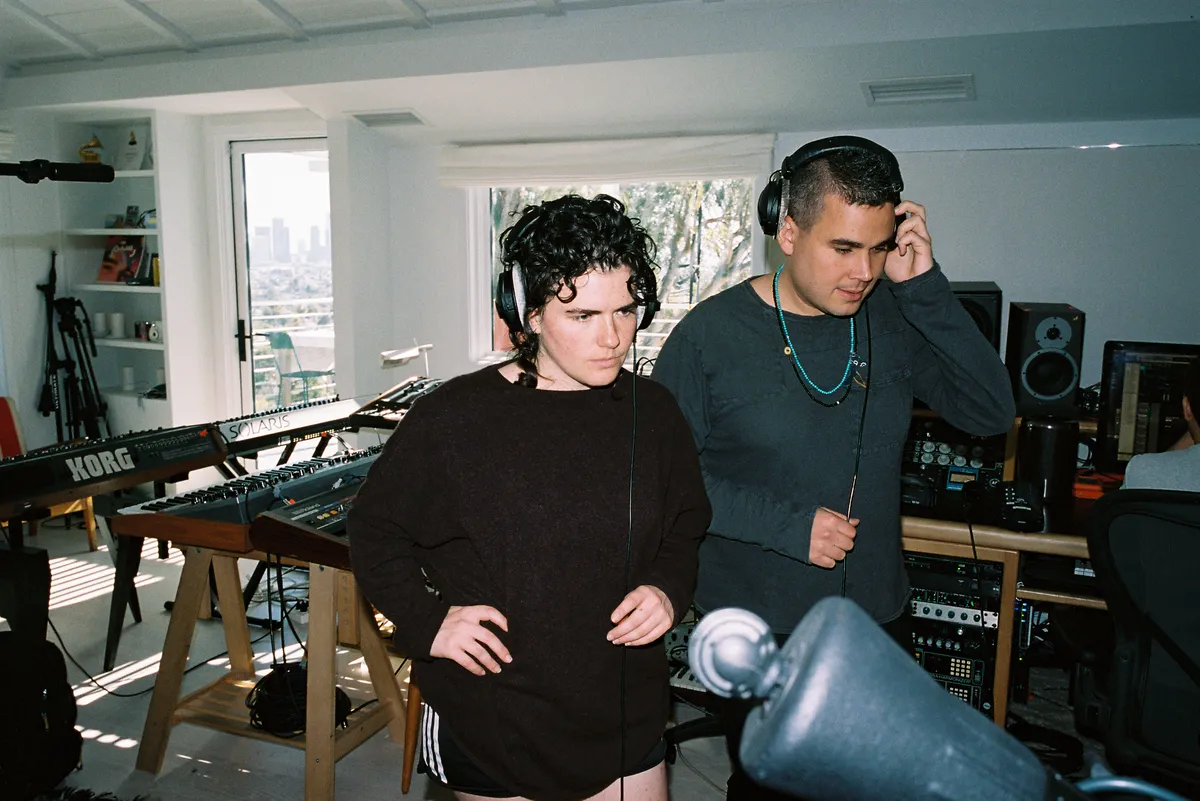
Working in Cavallo’s renovated six-car
garage-turned-recording studio with engineer
Doug McKean at a Pro Tools Icon
controller, MCR stacked tracks. Way, lead
guitarist Roy Toro, rhythm guitarist Frank
Iero, and bassist Mikey Way built up each
track, layering instruments, with Way cutting
vocals in the live room, often only minutes
after he’d penned the song’s lyric.
Basically a home studio outfitted with
pro gear, Lightning Sound has recorded
Shinedown and Paramour, among others.
Speed, adaptability, and recallability are
important factors in the studio’s working
process. “We use Telefunken V76s for
vocals and acoustic guitars,” McKean
explains. “But I also use Altiverb and
ReVibe plug-ins because Rob and I jump
around from project to project. It’s really a
matter of recallability. There are a lot of
presets in Altiverb, dialed-in IR rooms that
are copies of the reverb settings for specific
rooms; some of them sound better
than a lot of outboard reverbs. We have
an EMT plate, a Gold Foil plate, but I
can’t use them much except in the mixing
phase, because the recallability is tough
when you are juggling projects all day.
McKean runs drums through a Neve
Melbourne sidecar with 33114 modules.
Guitars, vocals, and acoustic guitars go
through an Aurora Audio MK GTQ-2 mic
pre, which McKean describes as a
“Neve copy. They are better or as good
as having real 1073s, because they are
little more open, but they have exactly
the characteristic.”
With proficiency in mind, most of the
equipment settings at Lightning Sound
are dialed in, each session adapting to
different artists. Though MCR used drum
machines before overdubbing drums,
McKean often begins with drums.
“I figure out placement while the band
isn’t here,” he relates. “I blend bass drum
mics: a Shure Beta 52 inside the kick
drum, blended with a Shure SM7 halfway
in the hole, then on a separate track, I’ll
record a Yamaha [SKRM100] Subkick. I
like the old Unidyne III for snare—very
similar characteristics to an SM57, but
with a peak around 4k, which is good for
snare drum. I mike under the snare drum
with an SM57 or a Sennheiser 451. For
toms, I always use [Sennheiser MD]
421s, angled directly at the head. I try to get it 90 degrees to the head to get
more tone. On overheads, I love using
the [Telefunken] ELAM 251s, although at
the studio, I also use AKG C24s. I put
the overheads right above the drummer’s
head; I don’t like the mics to be too onaxis
with the cymbals. I go a little behind
the drummer and point the diaphragms
right at the toms. For room mics, I use
AKG C12As in a Blumlein pair array [a
mathematically precise stereo miking
configuration] in the middle of the room.
And then another 251 or an SM7
pointed at the wall; I use a lot of compression
on that mic.”
McKean favors the Sony C800 for
guitar cabs, through the Aurora GTQ2.
“The Sony sounds great and different
from what everybody else uses,” he says.
“I get all the lows and nice midrange coverage.
It doesn’t sound too peaky in any
different spot in the midrange. It goes
right on the grill, between [the points]
where the dome glue is on the cone.”
Unlike many engineers, McKean
prefers miking bass cabs to going direct.
Lightning Sound has a re-issue Ampeg
and an SVT cabinet, which McKean mikes
with an SM7 or C800.
“I prefer much more amp sound, ’cause
it sounds bigger,” he explains. “It has more
character, more air around the note. Direct
is easy to mix into a track. An amp requires
work to make sure the low-end curve is
fitting into the drums and guitars.”
Tracking Gerard Way’s vocals was like
the rest of Danger Days—a lesson in
improvisation. Never more than four takes
were needed, with little or no punching-in
required. “Gerard liked to hang on the mic
and really rock out.” McKean says. “I used
an SM7 through a Telefunken V76 pre. It’s
a great mic pre that I use a lot on vocals; it
handles a lot of different types of levels
and different frequencies really well. Then
[the signal went] through an old bluestripe
UREI 1176, recorded flat because
the way they were working was so sporadic
and different. Sometimes Gerard
would sing an idea for a verse, then keep
part of it, then go back in. In that case, I
would EQ it in the computer so I could
get the same sound back easily on any
track. We’d only punch in for overlapping
lines but Gerard likes to perform the song
as much as he can top to bottom.”
“I start with a ton of reverb on my
vocals, but slowly go completely dry,”
Way adds. “When I am singing, I have a
ton of room and reverb in my ears,
because traditionally, when doing shows,
I am just hearing the room. I am so accustomed
to that. I want to feel like I am in a
theater in the studio.”
“There is a concept
to Danger
Days,” Rob Cavallo
concludes. “It’s
inspired by Gerard’s
unpublished graphic
novel, set in 2019: World War III has
already happened. It’s about the idea that
chaos creates true beauty. The line
between good and evil is not drawn in
black, it’s drawn in invisible ink. We
wanted to create anti-matter, because
matter is boring.”
Want more? Read interview extras with Gerard Way, Rob Cavallo, and Doug McKean HERE.